
Three Storage Types, Three Different Problems
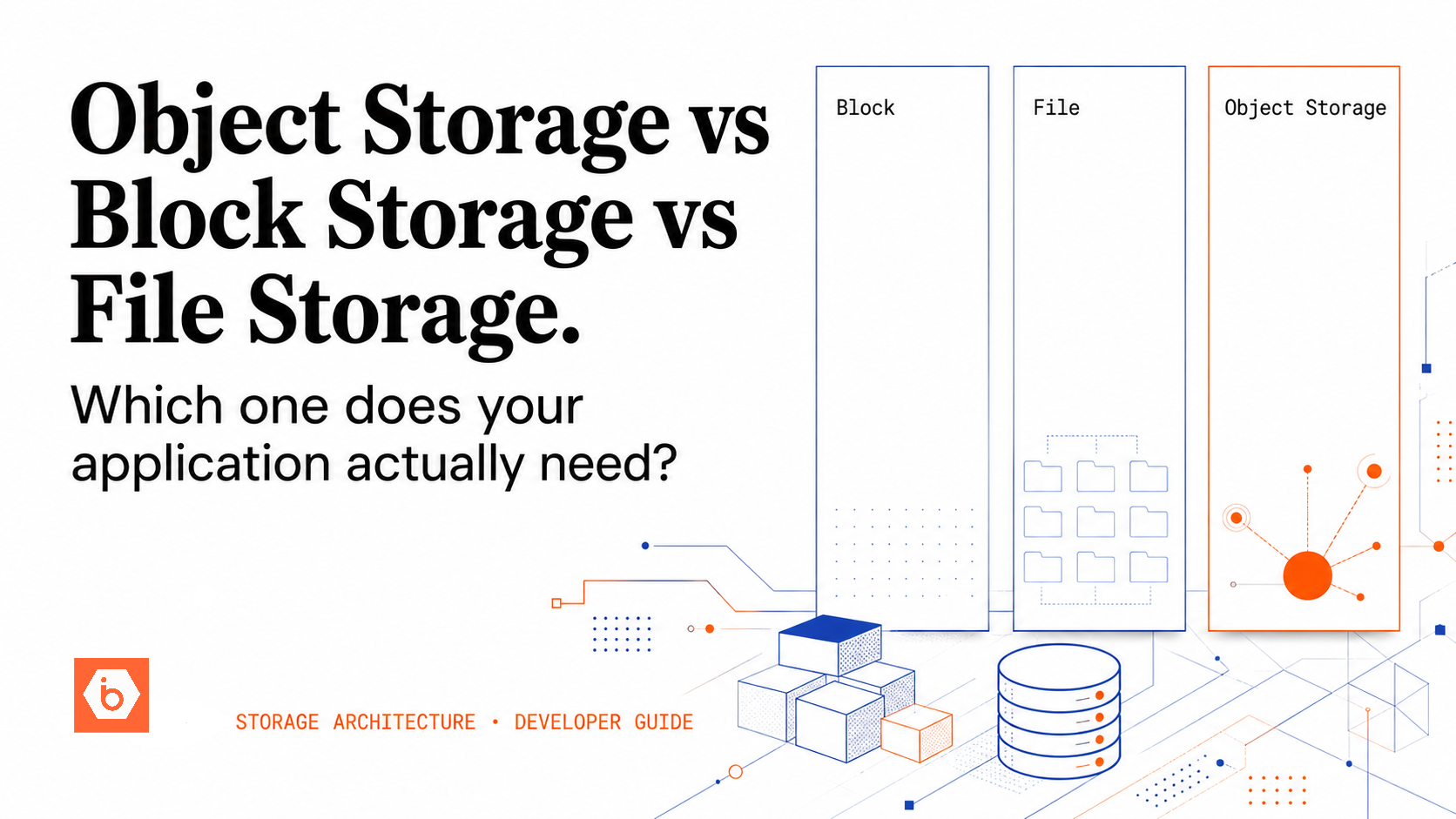
Storage is not a single category. Object storage, block storage, and file storage each emerged to solve different access patterns, at different scales, with different tradeoffs. Using any one of them for the wrong workload does not just create technical debt: it creates cost problems, performance problems, and architectural rigidity that compounds as the application grows.
Understanding the difference is not academic. It is the foundation of a storage architecture that scales correctly. The number of migration projects we have seen that trace back to an early decision to store user-uploaded files on an attached server disk is high enough that this distinction is worth understanding clearly before the first line of storage code is written.
Block Storage: The Raw Disk Abstraction
Block storage presents itself to the operating system as a raw disk. It does not know about files, directories, or objects. It knows about blocks, which are fixed-size chunks of data that the OS or application reads and writes by block address. The file system sits above the block storage layer and imposes structure on top of it.
The way it works is straightforward: the application writes data through the OS file system, which writes to block addresses on the block storage volume. The storage layer has no awareness of what the data means. It stores and retrieves blocks at the address specified, and does so with very low latency.
Block storage is the right choice for databases, operating system volumes, and any workload that requires low-latency random read and write access to structured data. A PostgreSQL database on a block storage volume, a MySQL instance on an NVMe-backed volume: block storage is what makes databases fast, because random seeks to specific block addresses are fast and consistent. IBEE's block storage volumes start at 50 GB for Rs.350 per month, with shared IOPS and throughput appropriate for production database workloads.
Block storage is not appropriate for storing large numbers of files, sharing data across multiple servers simultaneously, or storing unstructured media. Block storage volumes are typically attached to a single server. They do not scale horizontally without significant architecture work, and they are priced per provisioned GB regardless of how much of that capacity is actually used.
You will encounter block storage as the root disk on every cloud virtual machine: AWS EBS, Azure Managed Disks, GCP Persistent Disk, and IBEE block storage volumes all fall into this category.
File Storage: The Shared Directory Abstraction
File storage presents a familiar directory tree interface: folders, files, and paths. Unlike block storage, file storage can be accessed by multiple clients simultaneously over a network protocol such as NFS or SMB. It is what most people think of when they imagine a file server.
The storage system manages a file system with directories and files. Clients mount the storage over a network and interact with it using standard file operations: open, read, write, close, list directory, delete. The storage system handles concurrency, locking, and consistency across multiple clients accessing the same files at the same time.
File storage is the right choice for shared file systems where multiple servers need to read and write the same files, legacy applications designed around POSIX file system semantics, content management systems that expect a local directory structure, and workflow tools that process files sequentially using standard path operations.
File storage faces significant challenges at extreme scale. Storing billions of files, distributing content to internet-scale audiences, or replicating data across data centres and regions are all workloads that file storage was not designed for and does not handle efficiently.
You will encounter file storage as AWS EFS, Azure Files, and NFS shares in on-premise environments. A shared code repository mounted across multiple application servers is file storage. A CMS whose media uploads directory is mounted across a cluster of application servers is file storage.
Object Storage: The Web-Scale Unstructured Data Layer
Object storage replaces the file and directory metaphor with a flat namespace of objects. An object is a blob of data, any data, any size, any format, plus a key and a set of metadata. You store objects by key and retrieve them by key. There are no directories, no locking, and no concept of writing to the middle of an existing object.
The interface is simple: PUT an object to a bucket with a key, GET the object back by key, LIST objects in a bucket filtered by key prefix, DELETE objects by key. The HTTP-based API means any language, any platform, and any network-connected client can interact with object storage without a special protocol or mount point. This is a fundamental architectural advantage: your application server, your CDN, your data pipeline, and your mobile app can all access the same objects directly over HTTPS.
Object storage is the right choice for storing and serving large volumes of unstructured data: images, videos, audio files, documents, backups, log archives, ML datasets, and static web assets. It is designed to scale to billions of objects at petabyte scale, serve them at high throughput to many concurrent clients, and do so at a cost that reflects bulk storage economics rather than high-performance disk pricing. At IBEE, that is Rs.1.50 per GB per month for storage and Rs.2 per GB ($0.021/GB) for egress, with no minimum object size, no retrieval surcharge, and a free tier of 25 GB storage and 50 GB egress per month. All USD equivalents in this article use a conversion rate of Rs.94.91 per dollar as of May 2026.
Object storage is not appropriate for workloads that need POSIX file semantics. You cannot append to the middle of an object, you cannot list a true directory tree, and you cannot set Unix-style file permissions. Databases do not run directly on object storage. Applications that need to seek within a large file at arbitrary byte offsets will find the whole-object read model limiting.
You will encounter object storage as AWS S3, IBEE, Google Cloud Storage, and Azure Blob Storage. Every image CDN, every video streaming platform, every backup system, and every static website runs on object storage.
Follow the access pattern, not the familiar interface.
The S3 API as the Universal Interface
AWS S3 defined the dominant object storage API, a set of HTTP operations including PUT, GET, DELETE, LIST, COPY, HEAD, and multipart upload, that became the de facto standard for cloud object storage. The S3 API is now implemented by dozens of storage providers, including IBEE.
Full S3 compatibility means any application, SDK, CLI tool, or infrastructure component built for AWS S3 works with IBEE by changing the endpoint URL and credentials. No code changes to the application logic, no new SDK to learn, no migration of data pipelines. This is why S3 compatibility is a meaningful feature: it determines whether switching providers requires rewriting application code or just updating a configuration value.
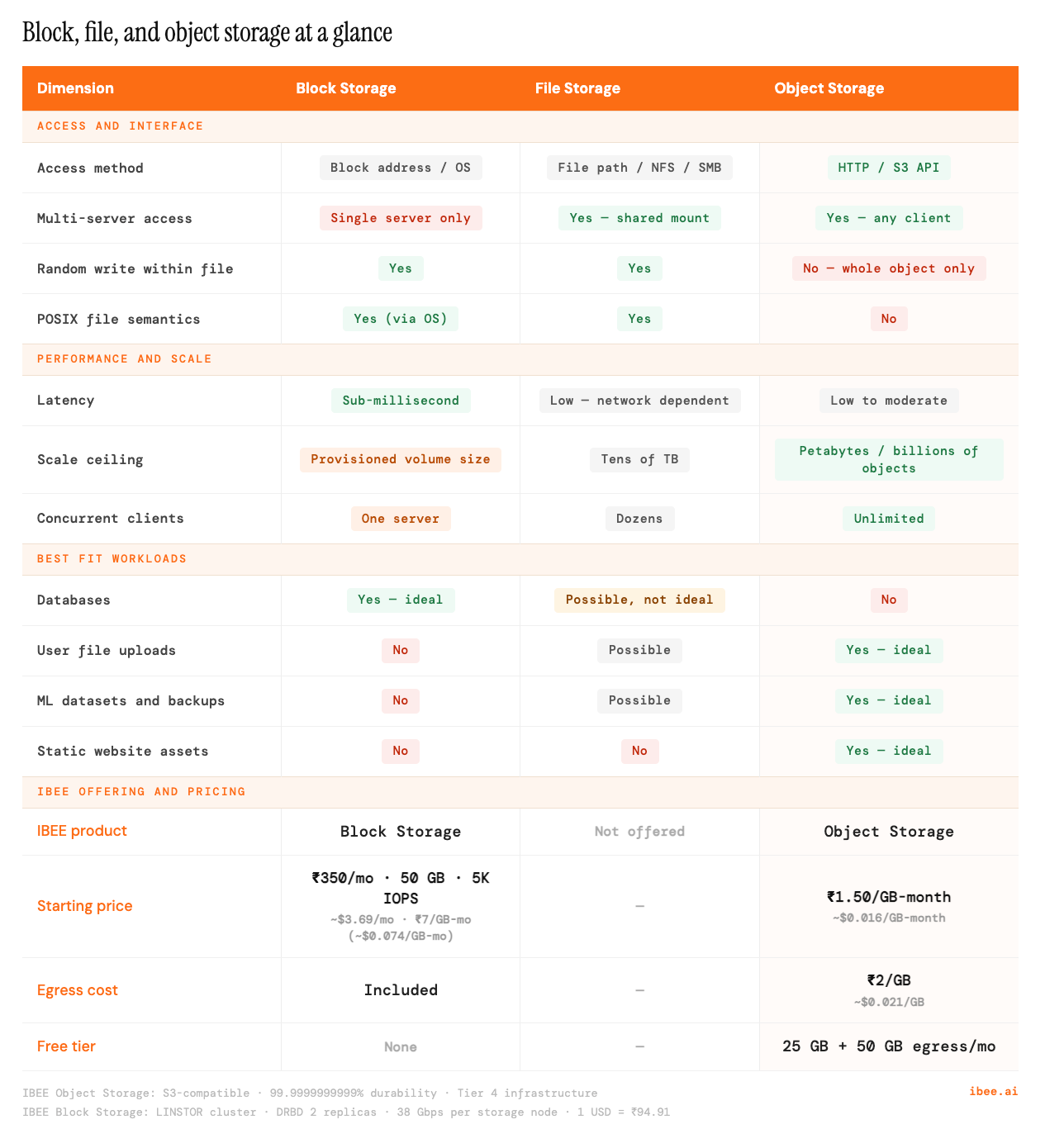
Compared across the dimensions that matter for an architecture decision.
Choosing the Right Storage Type
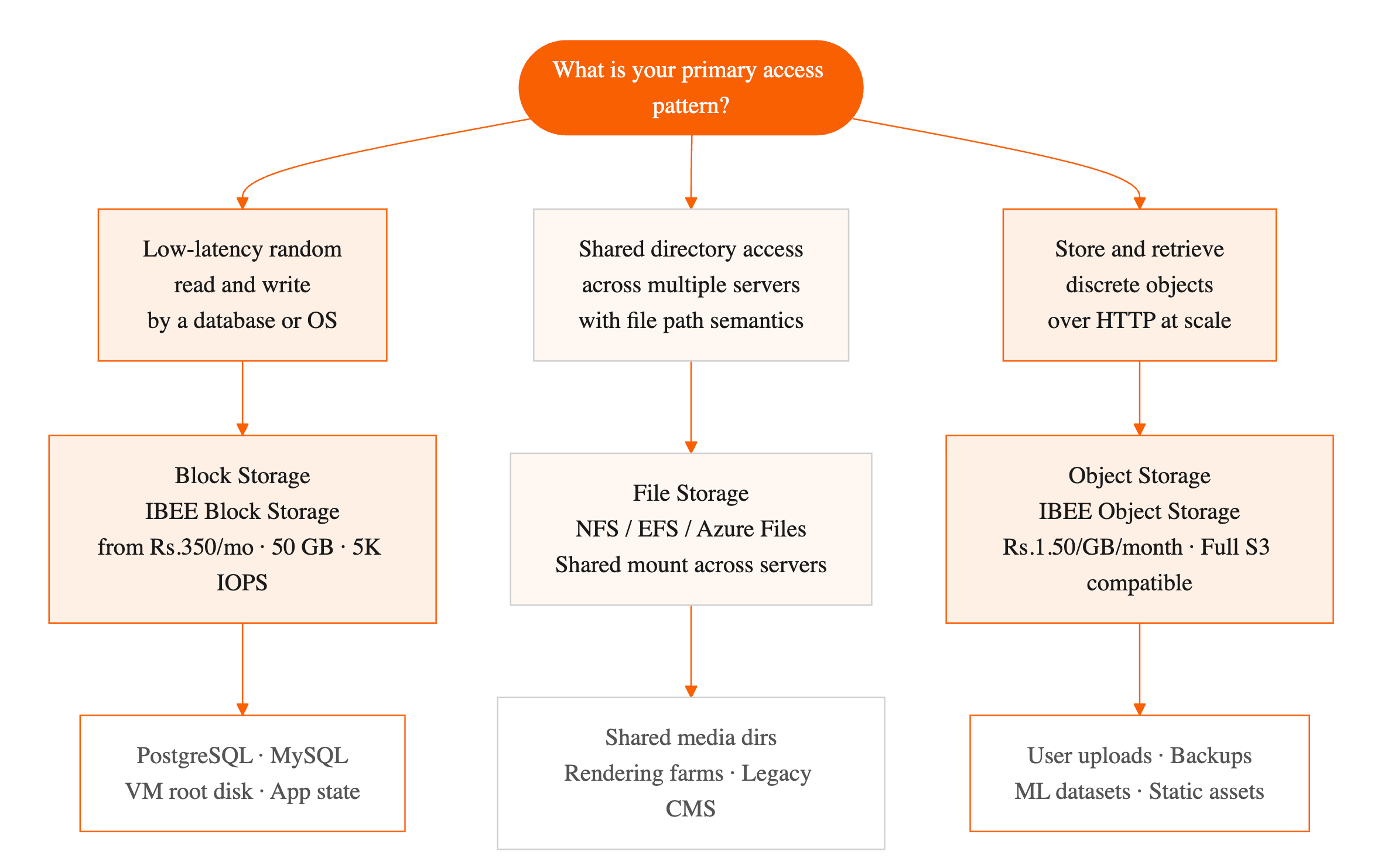
The decision for a given data storage requirement typically follows the access pattern of the data rather than its size or format.
If the data needs to be read and written with low-latency random access by a database or operating system, block storage is correct. Run PostgreSQL on a block storage volume, not on an NFS share, and not by writing database files to object storage.
If the data needs to be shared across multiple servers simultaneously with standard file semantics, shared file storage is correct. A rendering farm where multiple nodes write output frames to a shared directory, or a CMS whose media upload directory must be accessible across all application servers, are file storage use cases.
If the data is a collection of discrete objects that need to be stored at scale, retrieved over HTTP, served to end users or downstream systems, or archived for long retention, object storage is correct. User-uploaded files, media libraries, static website assets, ML training datasets, database backups, and log archives all belong in object storage.
Why Most Modern Application Data Belongs in Object Storage
The vast majority of data that web and mobile applications generate is unstructured and discrete: images uploaded by users, documents generated by the application, audio recordings, video files, reports, and exports. None of this benefits from the POSIX semantics of file storage or the block-level access of disk storage. All of it benefits from object storage's scale, cost efficiency, HTTP accessibility, and durability.
An application that stores user profile photos on a local disk attached to the application server has made a decision that will require a migration when the server runs out of disk space, when a second application server is added, or when the server is replaced. The same data in an object storage bucket scales indefinitely, is accessible from every server in the fleet, and survives any individual server failure without data loss.
IBEE Object Storage for Indian Applications
IBEE's S3-compatible object storage is built for Indian application workloads: storage at Rs.1.50 per GB per month, egress at Rs.2 per GB ($0.021/GB), Tier 4 reliability, and latency appropriate for serving Indian users from Indian infrastructure. For applications where data currently lives on attached server disks or shared NFS mounts, the migration to IBEE object storage is typically a day's work. The free tier of 25 GB storage and 50 GB egress per month requires no payment method, making it practical to validate the integration before committing to a migration.