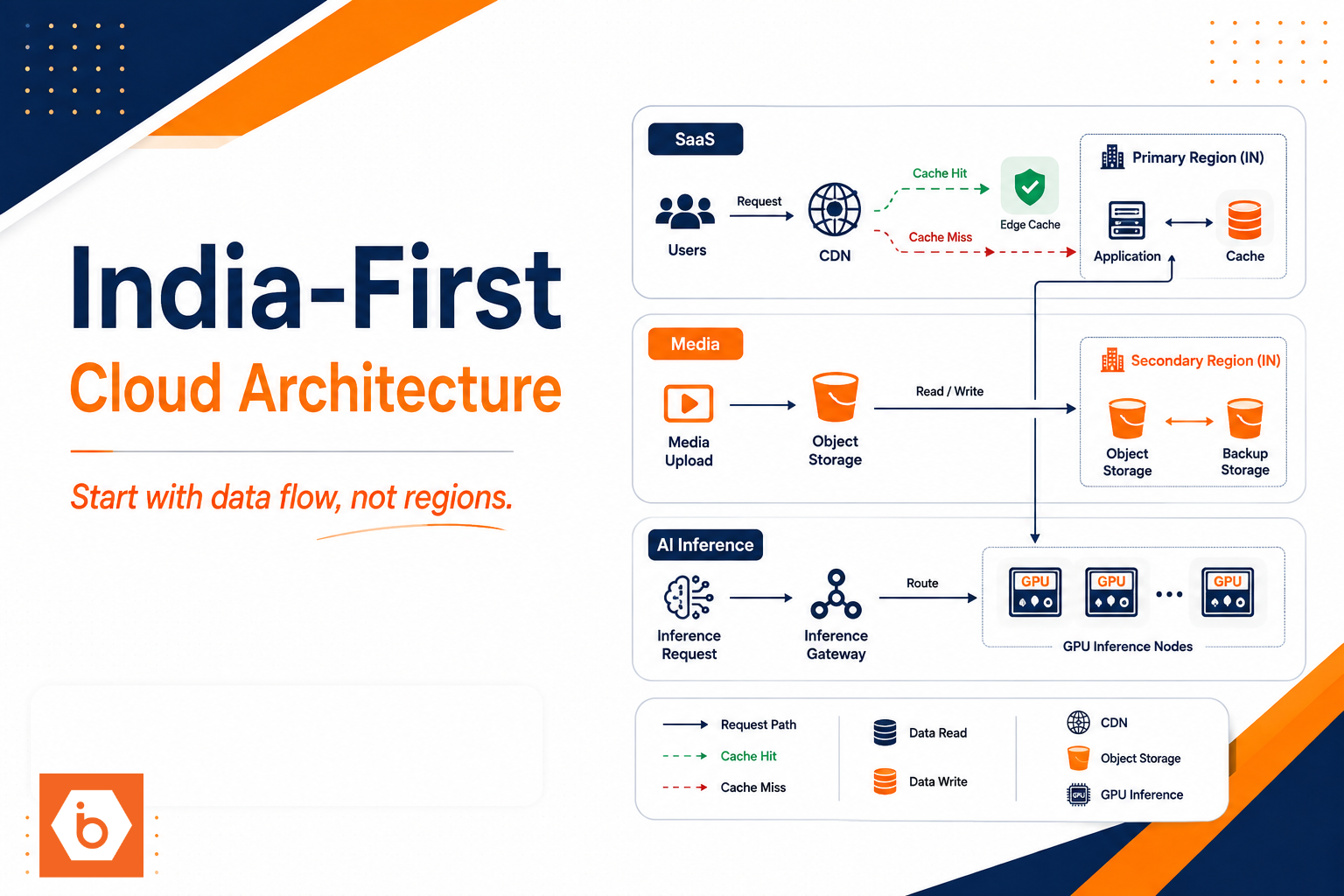

You shipped your SaaS in “the cheapest region you could find.” Then support tickets started: login works, but dashboards load like they’re stuck on dial-up. Media playback stutters. AI inference times swing wildly. Then finance asks why your bill doubled after you “just added caching.” You don’t have a cloud problem. You have an architecture and data flow problem.
Most teams get this wrong at the same point: they pick regions, Kubernetes, and storage first. Then they discover their real access patterns. That is backwards. Your system should start from how your product reads and writes data, how users access it, and what regulatory boundaries you must respect. Everything else is implementation detail.
The India-first constraint is really three constraints
“India-first” sounds like a slogan. In practice, you’re juggling three hard constraints at once.
First is latency. Indian users route differently depending on ISP and geography. If your origin is far away, your time to first byte and media start times suffer even if your app is fast. You fix this with regional entry points and edge caching, not by arguing about CPU types.
Second is governance. DPDP obligations push you to think about lawful processing, security safeguards, and cross-border handling. Even when you are not forced into strict localization for every dataset, you still need a posture that makes audits survivable. That usually means keeping sensitive data and operational logs in India, and controlling who can access them.
Third is unit economics. “Run everything in one place” often looks cheaper until egress and operational overhead hit you. If you store media and assets in one region and serve them from another, or you move logs and backups around without a plan, your costs drift. You need architecture decisions that keep traffic and storage aligned.
Here’s the blunt truth: you can’t bolt these constraints on after you choose your services. You must design the data paths and traffic paths from day one.
Required visual: India-first reference architecture
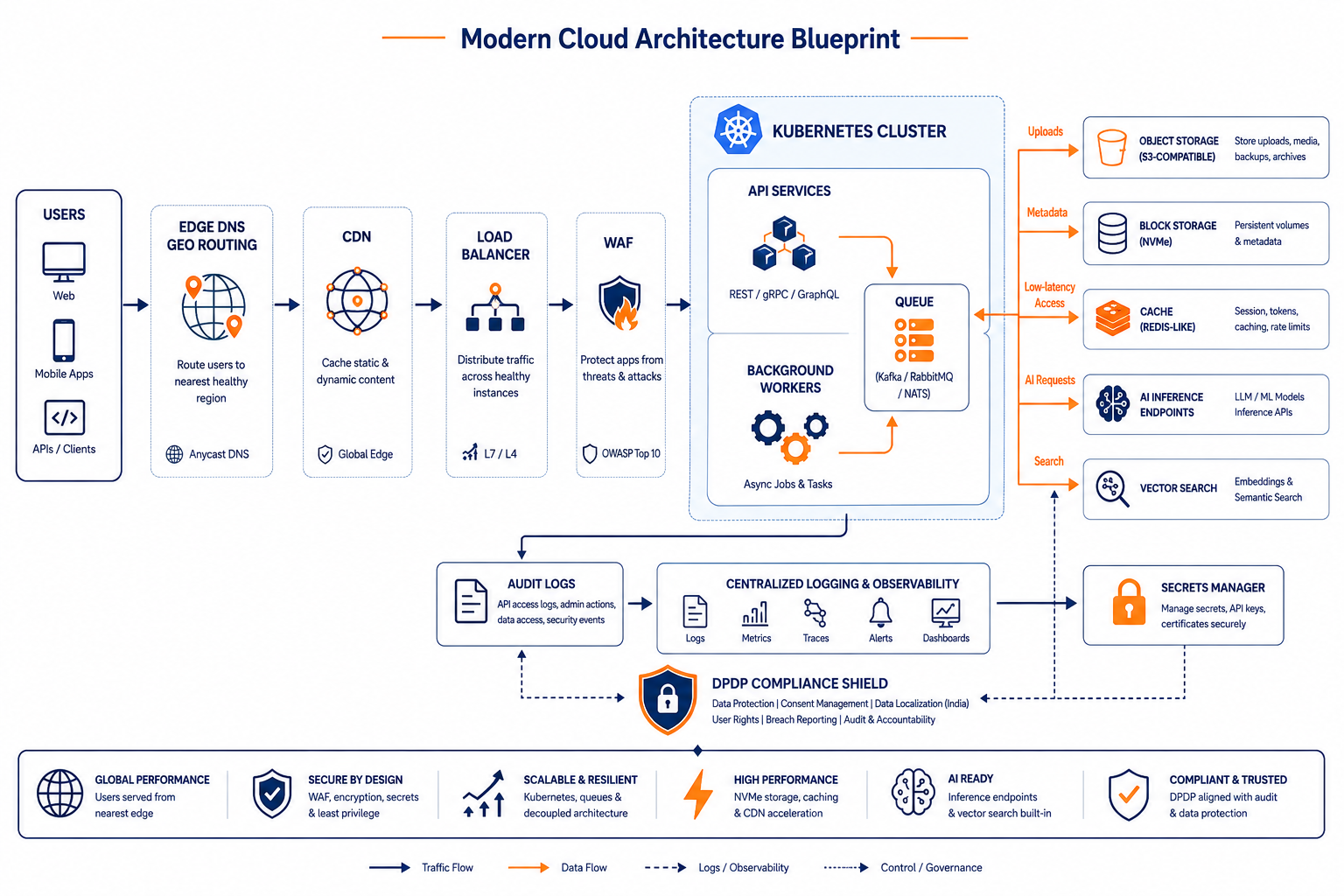
Shows how requests and data flow through edge, Kubernetes services, storage layers, and AI inference while keeping governance in mind
Start with access patterns, not services
You need a simple exercise your team can actually do in a day: write down your top 10 read paths and top 10 write paths. For each path, capture the access pattern and latency tolerance.
You are looking for answers to these questions:
Your reads are mostly “fetch by key” or “scan and aggregate”? Your writes are append-only events or mutable records? Do you need strong consistency or is eventual fine? Are you serving small objects frequently or large blobs streaming to players? Do you need search by embedding vectors?
Once you know that, the storage choices stop being political.
For SaaS, the core is usually relational data for users, accounts, billing metadata, and permissions. For high-throughput event streams and session-like data, you often add a NoSQL or event store. For media and user uploads, object storage wins because you decouple ingestion from delivery and you can run lifecycle rules without resizing disks. For AI, you separate the dataset store from the serving path. Training and evaluation want throughput and cheap durable storage. Inference wants low-latency endpoints and fast retrieval for context.
Most teams get this wrong when they treat everything like “database tables.” They end up forcing large binary assets through the relational layer. Then backups get expensive, migrations get painful, and your incident response becomes a nightmare because you can’t isolate blast radius.
Also: don’t overcomplicate multi-tenancy early. If you share a database across tenants, you must enforce tenant isolation in the query layer and in access control. If you split databases, you must automate provisioning and migrations. Either way, you need a plan that you can actually operate.
Build the SaaS data plane and the media data plane separately
SaaS traffic and media traffic behave differently. Mixing them in the same operational assumptions is how you get unpredictable bills and messy incidents.
For SaaS, aim for stateless API services behind a load balancer. Put background jobs behind a queue: emails, exports, billing reconciliation, webhook delivery retries. Cache hot reads like tenant settings and permission checks. Keep your audit logs separate from your application logs so you can retain them according to policy without drowning your debugging signal.
For media, treat ingestion, processing, and delivery as separate stages. Upload goes to object storage. Transcoding jobs run on compute workers and write outputs back to object storage. Delivery uses manifests and segmented chunks served through CDN. This design keeps your origin from handling every playback request. It also makes it easier to retry failed transcodes without re-uploading the source.
If you’re doing this right, your media pipeline becomes a set of idempotent steps. That matters during incidents. Most teams don’t plan for “retry storms,” so their pipelines amplify failures.
Here’s a real-world pattern you should recognize: a team starts with direct uploads to storage, then later adds thumbnails, then later adds DRM, then later adds multiple renditions. If your storage and job orchestration aren’t designed for that growth, you end up rewriting the pipeline while users are already consuming it. The fix is to standardize the asset layout and metadata model early.
AI needs two architectures: training storage and inference serving
AI breaks teams because they assume the training pipeline and the inference pipeline have the same bottlenecks. They don’t.
Training wants throughput, dataset management, and repeatability. You need reliable dataset storage, versioning, and fast access for preprocessing. You also need evaluation artifacts and model registry metadata tracked with auditability. Most teams get this wrong by storing datasets in ad-hoc folders on block storage attached to a VM. That works until you scale preprocessing and your throughput collapses.
Inference wants low latency and stable autoscaling. You serve requests from inference endpoints. You also need fast retrieval for RAG: vector search, metadata filters, and consistent embedding versions. When retrieval is slow, your model is “slow” even if the GPU is fine. When retrieval returns the wrong tenant data, you have a security incident, not an ML bug.
Now tie it back to India-first. If your vector index, metadata, and inference endpoints are not co-located with your user traffic path, your p95 latency spikes. And if you store sensitive prompts or retrieved documents outside your governance boundary, you create audit risk.
If you run your inference and your storage in India, you can also reduce cross-region data movement. That often shows up as fewer surprise egress charges and fewer “why is this region different” debugging sessions.
Security and compliance are part of the architecture, not a checkbox
You need a baseline that your engineering team can follow without memorizing a checklist.
Start with identity and access management. Use least privilege for services and human users. Separate duties: the service that reads objects should not also be able to delete them. Encrypt data in transit and at rest. Manage secrets centrally, not in environment variables sprinkled across repos.
Next, make audit logging a first-class citizen. Don’t just log “app events.” Log access to sensitive data, changes to permissions, and key admin actions. Retain audit logs according to policy and store them in a way that supports forensic queries.
Finally, design for incident response. Your goal is not “we can detect.” Your goal is “we can contain.” That means blast radius boundaries: per-service permissions, per-tenant access controls, and storage separation so one compromised workflow cannot exfiltrate everything.
If you do this, your compliance posture becomes operational reality. If you don’t, you’ll discover the gap during the first serious incident, when you need evidence and you don’t have it.
Mid-article optional visual: traffic and data flow decisions
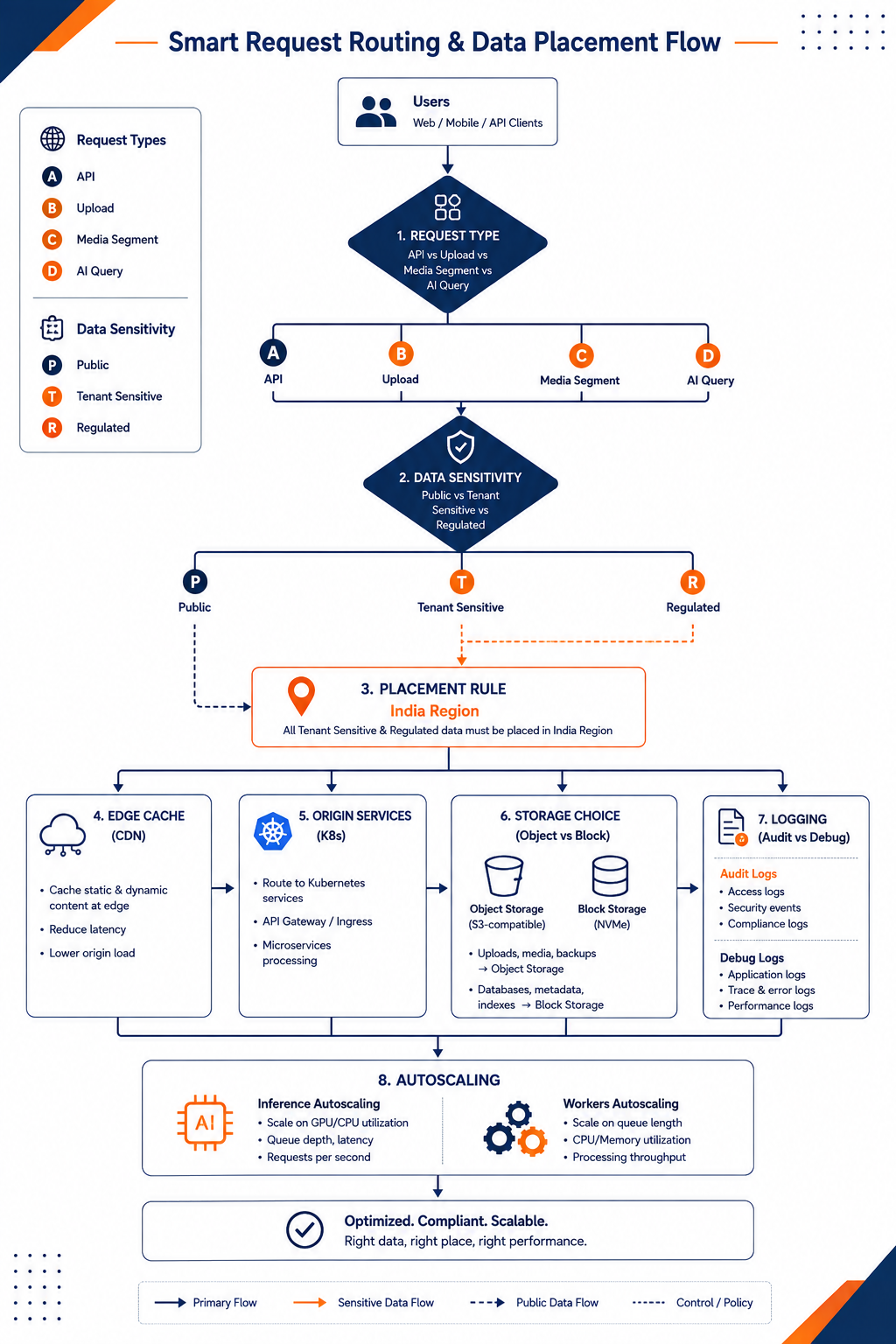
A decision flow that maps request type and data sensitivity to the right placement and service choices
A practical rollout plan that won’t break your roadmap
You don’t need a big-bang rewrite. You need an ordered sequence that prevents the “we’ll fix it later” trap.
- Write your top read and write paths for SaaS, media, and AI. Assign each path a latency target and a sensitivity level.
- Choose region placement based on those paths, not on what’s trendy. Keep sensitive data and audit logs in India.
- Split storage by access pattern: object storage for uploads and media assets, block storage for low-latency state, and a database for transactional SaaS data.
- Build the traffic plane: CDN for static and media segments, load balancers for API and inference, and queues for async work.
- Implement security guardrails early: least privilege, encryption, centralized secrets, and audit logs with retention controls.
- Load test with realistic access patterns. Validate p95 latency for APIs, playback start time for media, and retrieval latency for RAG.
- Add cost visibility tied to architecture. Track egress, storage growth, and job retries so you can correlate changes to bills.
One more thing. Don’t let your team “optimize” by randomly adding caches. Caching without access pattern clarity turns into stale data incidents and wasted spend.
One concrete action you can take today
Pick one critical workflow you support now. Write its end-to-end data path on a whiteboard: where the request starts, where it hits compute, what it reads and writes, where the logs go, and where the user-visible response comes from. Then mark which parts are currently outside your intended India-first boundary. Fix that path first. That single change will teach you more than any architecture doc.