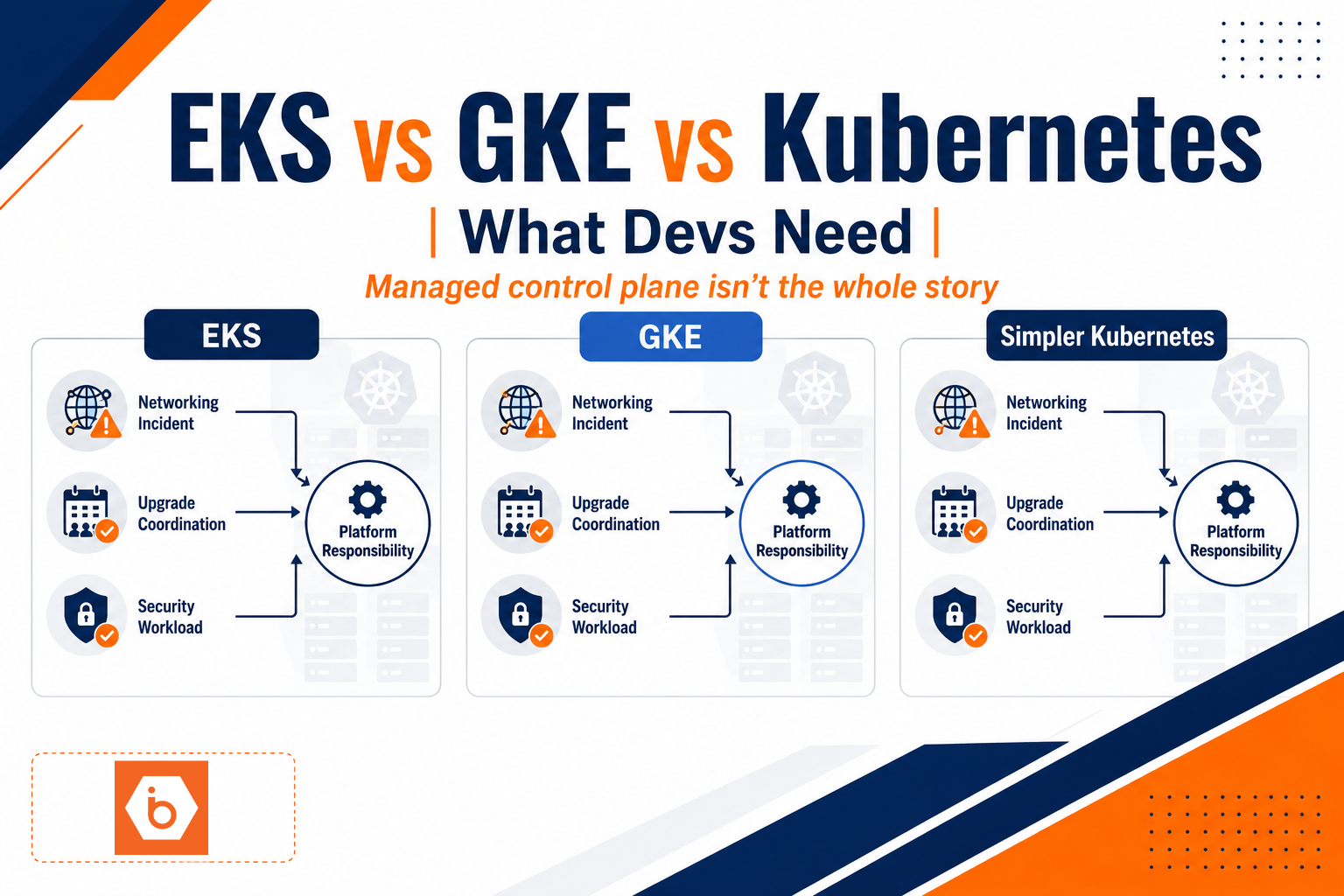

Most teams don’t choose EKS, GKE, or “simpler Kubernetes” because of features. They choose because someone on your team already knows one cloud, or because a blog post said “managed control plane” like that’s the whole story.
Then the real pain shows up six months later: networking incidents, upgrade coordination chaos, and security work that never ends. Your developers stop shipping features and start babysitting clusters. That’s not a Kubernetes problem. That’s a platform responsibility mismatch.
Here’s how to decide what you actually need, based on what developers do every day: provisioning, networking, security, observability, and predictable operations.
The failure mode you should plan for (not the marketing)
The uncomfortable truth: most teams choose their Kubernetes platform before they understand their workload and access patterns. They also underestimate how much time developers spend on “platform glue” that the provider does not fully own.
The most common failure looks like this. You pick EKS because you’re on AWS, or you pick GKE because your org already runs Google Cloud. Then you discover that your biggest risks are not the control plane. They’re the parts around it:
- Ingress and TLS termination decisions you made early
- CNI and routing behavior that affects latency and debugging time
- Identity mapping from IAM or cloud IAM to Kubernetes RBAC
- Logging and metrics pipeline gaps that cause “we can’t see what’s wrong”
- Upgrade windows where one add-on breaks and you lose a day
Most teams get this wrong in a very specific way: they treat “managed Kubernetes” as “managed everything.” It isn’t. AWS and Google manage the Kubernetes control plane, but you still own cluster add-ons, node lifecycle choices, networking integrations, and the operational habits around releases.
So your decision should be about who owns the operational burden you care about. Not which logo looks better in a slide deck.
What developers actually need day-to-day
When your engineers say “we need Kubernetes,” they usually mean they need outcomes, not a platform name.
First: fast, repeatable environments. Your dev and staging clusters must spin up predictably, use consistent configuration, and support safe rollbacks. If creating a cluster takes weeks, you’ll stop using staging “for real” and your release process gets riskier.
Second: operational reliability without platform babysitting. Your team wants fewer “cluster is broken” pages. That comes from stable networking and DNS behavior, automated node repair, and clear upgrade paths for both Kubernetes and the add-ons you depend on. If you regularly coordinate versions across multiple moving parts, you will burn engineering hours.
Third: security that doesn’t slow shipping. You need identity integration that maps cleanly to Kubernetes RBAC, a secrets story that doesn’t leak credentials into manifests, and audit trails that answer “who changed what.” If your security setup requires manual steps every time a service is deployed, your developers will work around it.
Fourth: observability that answers real questions. Metrics, logs, and traces are not “nice to have.” When an incident hits, you need to know whether the problem is pod crashes, upstream timeouts, load balancer behavior, or database latency. If your dashboards only show CPU and memory, you’ll guess.
Fifth: cost predictability. Developers do not want surprise bills from load balancers, cross-zone traffic, logging retention, or mis-sized node pools. They want autoscaling that behaves as expected and a clear way to reason about spend by environment and workload.
Now the decision becomes straightforward: EKS and GKE can both meet these needs, but “Simpler Kubernetes” often wins when it reduces the number of platform decisions your team has to own.
Required visual: how the pieces map to responsibility
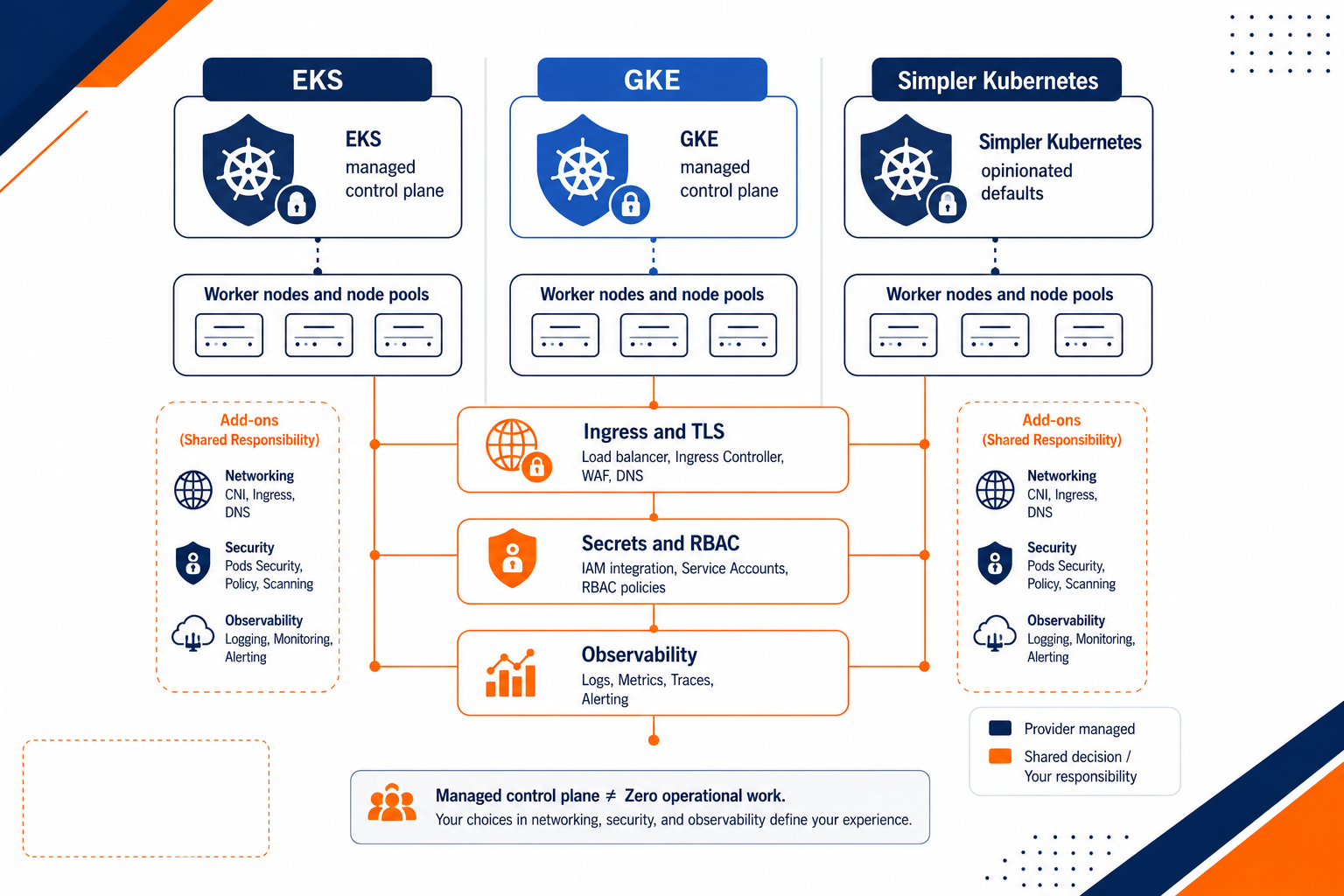
Shows what the provider manages versus what your team still owns for day-to-day developer outcomes
EKS vs GKE vs “Simpler Kubernetes”: where the developer experience diverges
Let’s skip the generic “managed service” talk and look at the actual differences that change your team’s workload.
Cluster lifecycle and upgrades
Both EKS and GKE manage the Kubernetes control plane. You still manage worker nodes and the add-ons you run on top. That means upgrades still require coordination: Kubernetes version compatibility, add-on compatibility, and any custom controllers you deployed.
Where teams feel the difference is in how much automation you get around add-ons and release orchestration. “Simpler Kubernetes” tends to win here because it ships opinionated defaults and automated upgrade workflows. The downside is you trade flexibility for speed. If you need unusual networking behavior or bespoke security policies, you may fight the abstraction.
Networking and ingress
Networking is where Kubernetes complexity becomes real. You’ll touch CNI choices, service exposure types, ingress controllers, TLS termination, DNS, and sometimes load balancer integrations.
EKS and GKE both integrate deeply with their cloud networking stacks, which can be a big advantage if you want predictable behavior and fewer “how does this route traffic” mysteries. But you still have to configure the integration correctly and keep it consistent across clusters.
“Simpler Kubernetes” usually reduces the number of networking decisions you make. That’s great for teams that want to ship. It can be painful if your platform team wants to experiment with multiple ingress patterns or custom routing logic.
Security and identity
This is another place where developers feel the platform, not the marketing. You need a clean mapping from cloud identity to Kubernetes RBAC, plus a secrets approach that avoids leaking credentials.
EKS and GKE integrate with their respective IAM systems, and that can make access control more consistent with the rest of your org. The operational risk is when identity and RBAC drift across clusters because teams configure it manually.
“Simpler Kubernetes” typically standardizes security patterns, which reduces drift. The trade-off is that you must accept the platform’s model. If your org has a unique compliance requirement or an unusual identity provider flow, you may need to customize the abstraction.
Observability and incident response
If your observability stack is inconsistent across clusters, debugging becomes slow. You end up with “works on cluster A” and “dashboard missing on cluster B,” and every incident turns into a scavenger hunt.
EKS and GKE often provide strong managed integrations, but you still need to design and maintain your logging, metrics, and tracing pipelines. “Simpler Kubernetes” tends to bundle more opinionated observability defaults, which reduces setup time and makes incidents easier to triage across environments.
The downside is cost and retention behavior. Opinionated stacks can also make it harder to optimize logging volume early, which matters when you start scaling environments.
Cost predictability
Cost is where teams lie to themselves. They think EKS vs GKE is the main cost driver. It’s not. Your architecture and usage drive most of the bill: node sizing, autoscaling behavior, logging volume, and traffic patterns.
What differs is how predictable the platform makes those costs. “Simpler Kubernetes” often enforces guardrails and defaults that prevent runaway configurations. But those guardrails can also block the exact optimizations your cost model needs later.
If your team is already good at cost engineering, EKS or GKE with disciplined platform standards can be just as predictable. If you’re not, “simpler” reduces the chance you’ll accidentally create a money leak.
One real example: the upgrade that cost a week
A mid-size SaaS team I worked with had both Kubernetes experience and cloud experience. They chose EKS because their infrastructure team lived in AWS. Everything looked fine until a routine add-on upgrade. One ingress controller version mismatch caused TLS handshakes to fail for a subset of services.
The control plane was managed. That wasn’t the issue. The issue was the operational surface area around it: compatibility between ingress, service annotations, and load balancer behavior.
They lost a week because nobody had a repeatable preflight process. No automated compatibility checks. No canary cluster with the exact same add-ons. No rollback plan that was tested, only planned. The developers didn’t need “better Kubernetes.” They needed a platform process that makes upgrades boring.
That’s the decision point you should optimize for: how boring are upgrades, networking changes, and security rollouts?
Where “Simpler Kubernetes” actually helps (and where it can trap you)
“Simpler Kubernetes” sounds vague because it is. But the pattern is consistent: it removes decisions and automates the boring parts. That helps most when your team lacks platform bandwidth, or when you need consistent environments across many services.
You should consider it when your platform team is small and your developer teams are big. If you have ten application teams and only two platform engineers, you cannot afford every team to make their own networking and security choices.
You should be cautious when you need deep customization. If you plan to run unusual network policies, advanced routing, or highly custom controllers, an opinionated platform can slow you down. Also watch for hidden coupling. If your platform wrapper makes it hard to swap ingress controllers or observability backends, you might feel trapped later.
So the real question is not “Is EKS or GKE better?” It’s “How much platform responsibility do you want to keep?”
If you want to keep responsibility, pick EKS or GKE and build strong standards: infrastructure as code, consistent add-ons, and automated upgrade validation.
If you want to reduce responsibility, pick “simpler Kubernetes” and accept the trade-off: fewer choices now, fewer surprises later.
Your concrete next step today
Stop debating platforms. Write a one-page “platform responsibility contract” for your team. Answer these questions in plain language:
- Who owns cluster upgrades and add-on compatibility checks?
- What networking standard will every service use for ingress and TLS?
- How does identity map to Kubernetes RBAC, and who maintains that mapping?
- What observability baseline is required before a service can go to staging?
- What cost guardrails exist for node pools, load balancers, and logging retention?
Once you have that, you can evaluate EKS, GKE, and simpler Kubernetes based on fit. Not vibes. And if you want, you can implement the contract as templates in your deployment pipeline so developers never have to “figure it out” at 2 AM.
If you do only one thing today: draft that contract and get your platform and security leads to sign off. That decision will save you months of churn.