
Audio Infrastructure Is a Pure Egress Business
Unlike video, which trades quality for bitrate with adaptive streaming, audio has simpler delivery mechanics: a file is downloaded or progressively played from start to finish. The infrastructure design is correspondingly simpler, but the egress cost structure is identical. Every byte of audio delivered to a listener is egress from your storage origin or CDN.
India is among the fastest-growing podcast and audio content markets globally, driven by smartphone penetration, affordable data, and a surge in regional language content. An audio platform that builds its infrastructure on hyperscaler storage at seed stage and does not revisit the decision at 100,000 monthly listeners will have an egress bill that materially affects its unit economics before the Series A conversation begins.
The Audio Egress Calculation
A 45-minute podcast episode at 128kbps MP3 is approximately 40 MB. At 96kbps AAC, which delivers broadly equivalent perceptual quality at a lower bitrate, the same episode is approximately 32 MB.
One hundred thousand monthly listeners each downloading one 40 MB episode produces 4,000 GB of egress per episode per month. At AWS S3 Mumbai at Rs.10.37/GB ($0.1093/GB), that is Rs.41,480 (~$437) per episode per month per 100,000 listeners. All USD equivalents in this article use a conversion rate of Rs.94.91 per dollar as of May 2026. A catalogue of 50 episodes with 100,000 listeners each produces Rs.20.74 lakh (~$21,852) per month in egress from a single show.
At IBEE at Rs.2/GB ($0.021/GB), the same 4,000 GB is Rs.8,000 (~$84) per episode per month. The 50-episode back catalogue costs Rs.4 lakh (~$4,215) per month in egress, a Rs.16.74 lakh (~$17,638) monthly saving on a single show.
For a podcast network with 10 shows and combined listenership of 500,000 per month, the infrastructure cost difference between hyperscaler and IBEE egress pricing is approximately Rs.83.7 lakh (~$88,189) per month.
The table below shows the egress cost comparison across these scenarios.
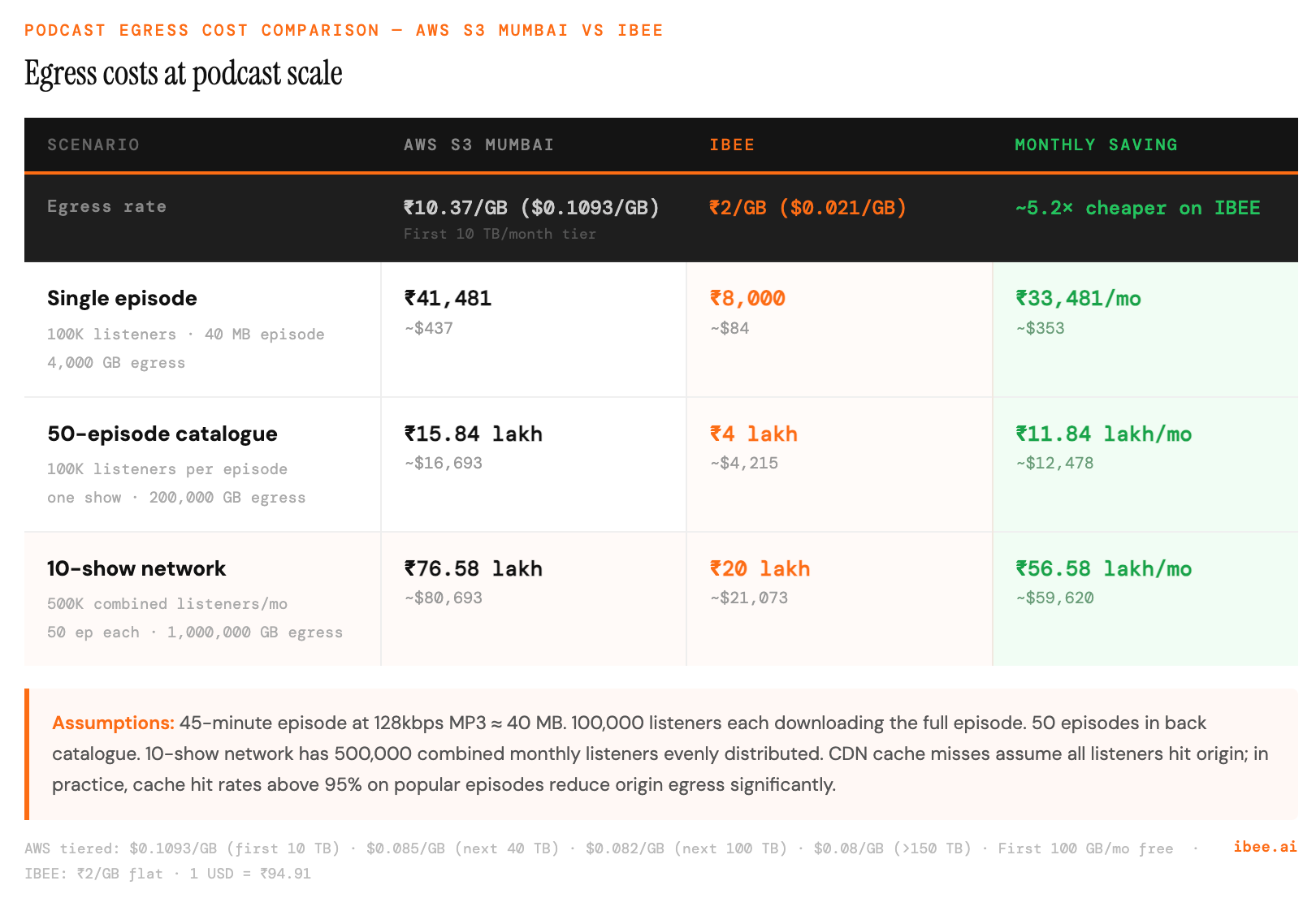
The cost difference between hyperscaler and IBEE pricing compounds quickly with catalogue size and listenership.
Storage Structure for Audio Platforms
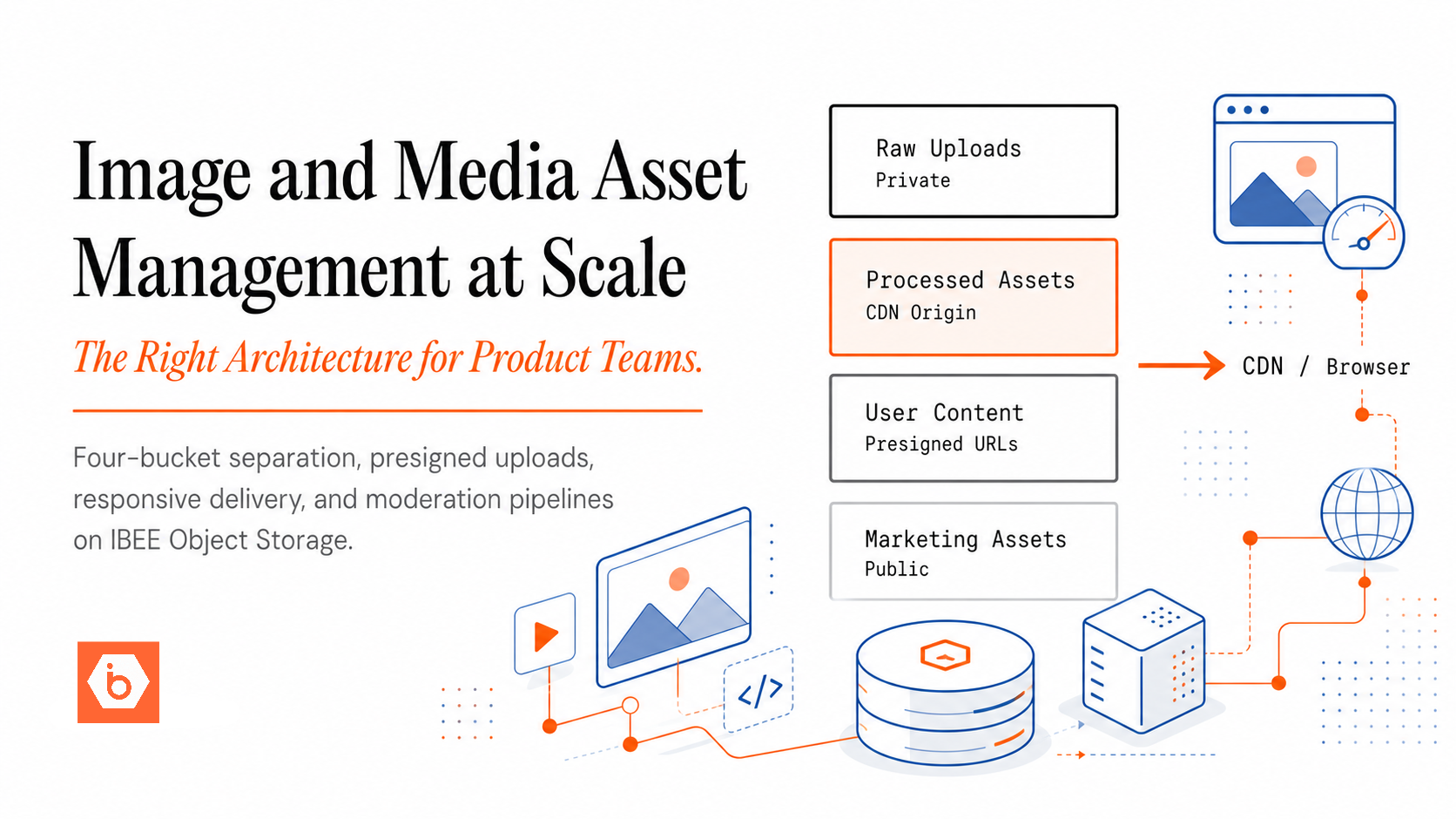
Raw Audio Bucket (Private)
Master recordings as delivered by creators or produced in-house: uncompressed WAV or high-bitrate MP3, before any processing. This bucket is private and never publicly accessible. It is a write-once preservation layer. If a processing step produces incorrect output, reprocessing runs from the raw master. Object keys encode the show identifier and episode identifier so any master can be located directly. Full bucket configuration examples for IBEE are available at ibee.ai/docs.
Processed Audio Bucket (CDN Origin)
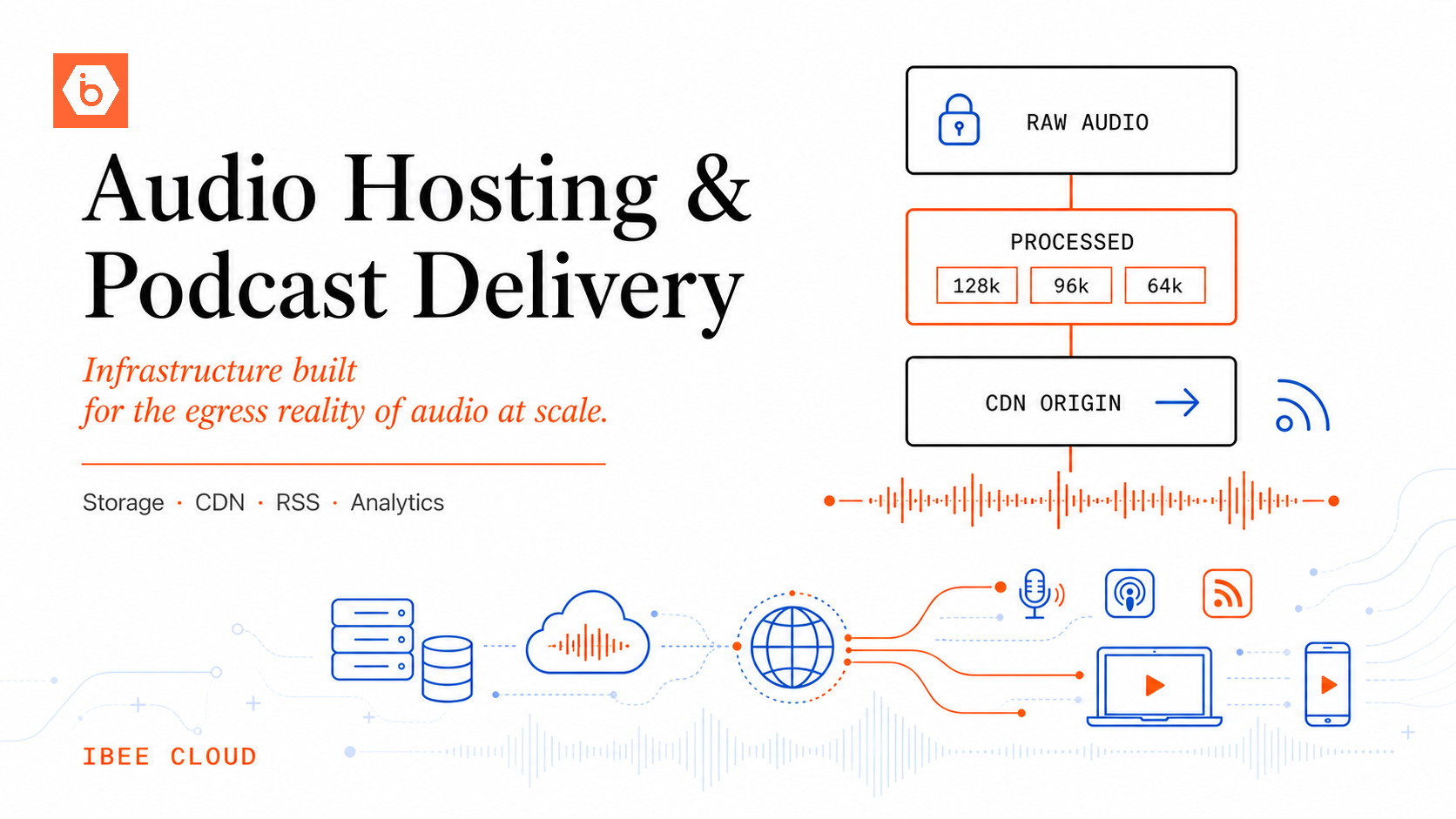
Transcoded delivery files: multiple bitrate variants of each episode, normalised for volume consistency. A typical set of variants includes 128kbps MP3 for maximum directory compatibility (the most widely supported audio format across all podcast apps and directories), 96kbps AAC for mobile streaming apps, and 64kbps AAC for low-bandwidth listeners. Object keys encode the show identifier, episode identifier, and variant name, making it straightforward to list all variants for a given episode and to invalidate CDN cache when an episode is updated. This bucket is the CDN origin and is not directly publicly accessible.
Artwork and Metadata Bucket
Show cover art, episode artwork, transcripts, chapter marker files, and show notes images. These are small files with a high cache hit rate and relatively static content. A separate bucket allows different lifecycle and access policies to be applied without touching audio files.
Audio Processing Pipeline
When a raw episode upload arrives in the raw bucket, the processing pipeline transcodes it into delivery formats and normalises loudness to -16 LUFS, the broadcast standard for podcasts. FFmpeg handles the transcoding from the raw master format into each delivery variant. The processed variants are written to the processed audio bucket with appropriate content type headers. Because published audio files never change, each variant is written with an immutable long-duration cache header, allowing CDN nodes and browsers to cache the file for up to one year without revalidation. Full transcoding pipeline configuration and cache header examples are available at ibee.ai/docs.
Podcast RSS Feed Architecture
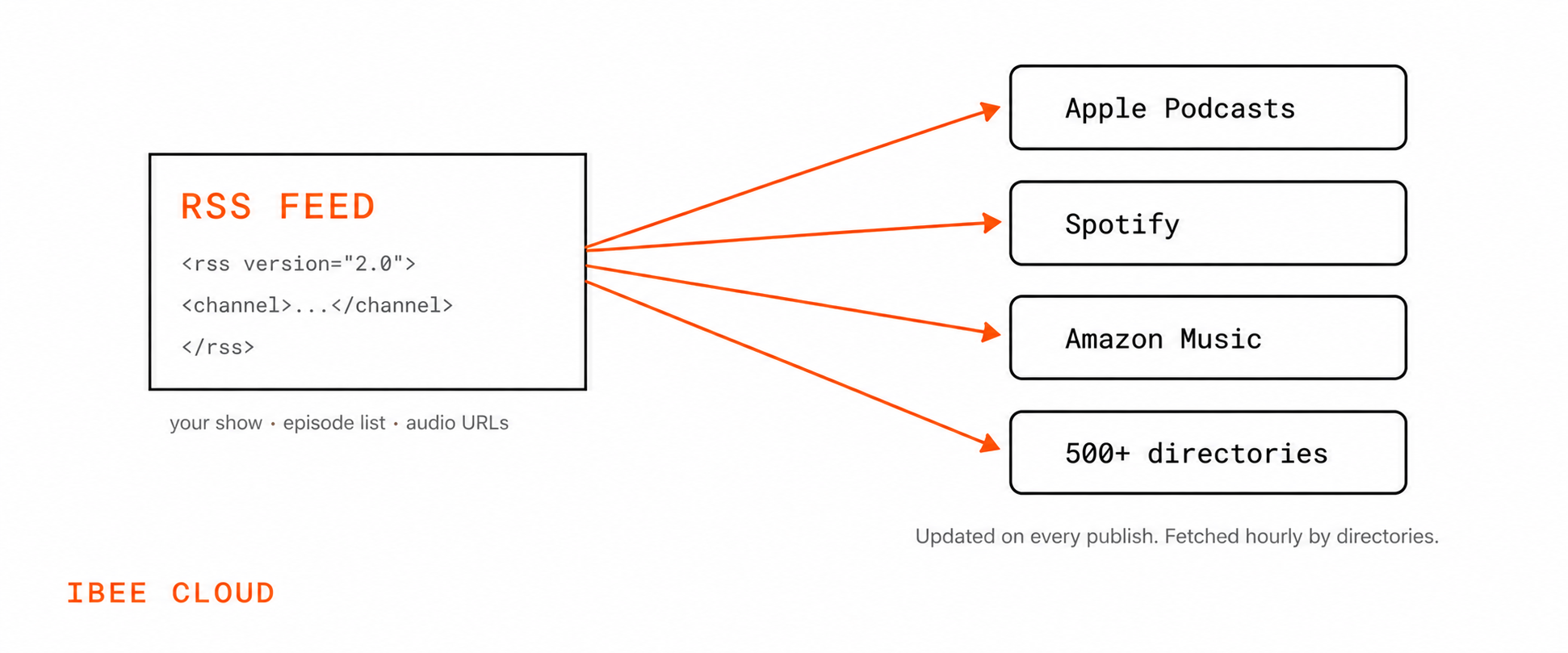
The podcast RSS feed is the distribution mechanism to Apple Podcasts, Spotify, Amazon Music, and every other podcast directory. The feed is an XML document that lists every episode with metadata and the direct audio file URL.The illustration below shows how a single RSS feed distributes your audio catalogue to every major podcast directory simultaneously.
The Feed Document
The feed itself is a dynamic document generated by your API or a static file updated on each publish. Because podcast directories fetch the feed frequently, often hourly, the feed URL must respond quickly. Serve the feed from your application server or from a CDN-cached static file in object storage, not from a slow database query on each request.
Audio URLs in the Feed
Audio URLs in the feed must be direct HTTP links to the audio files. Most podcast directories download the file directly from the URL in the feed. If your audio files are in a private bucket served via presigned URLs, those URLs are not suitable for podcast RSS feeds because they expire. Directories that cache the feed and fetch episodes later will encounter expired URLs.
For podcast delivery, audio files should be in a publicly accessible bucket or served via a CDN with public access. Presigned URLs are appropriate for premium subscription-gated content in an app, not for standard RSS-distributed podcasts.
Analytics Tracking
Podcast download counting for IAB-compliant analytics requires routing download requests through your application before redirecting to the actual audio file, since direct CDN delivery does not produce a verifiable download event by IAB measurement standards. The standard pattern is to include URLs pointing to your tracking endpoint in the RSS feed. When a podcast app requests an episode, it hits the tracking endpoint, which logs the request and immediately issues an HTTP 302 redirect to the actual audio file URL on IBEE. A 302 redirect is used rather than a 301 because 301 redirects are cached permanently by podcast apps, which means subsequent download attempts go directly to the audio file and bypass the tracker entirely. The tracking endpoint handles the logging; IBEE handles the delivery.
Caching Strategy for Audio Files
Audio files are large and immutable, making them ideal CDN caching targets. Once an episode is published and written to the processed bucket, it never changes. Configure the CDN to cache audio files with a maximum age of one year. For popular episodes, CDN cache hit rates above 95% are achievable. The first listener's download fetches from the IBEE origin. Every subsequent listener within the CDN cache window is served from cache without an origin request. The origin egress cost per listener trends toward zero for popular content.
For the long tail of a large catalogue, episodes with low ongoing listener counts may be evicted from CDN cache for lack of access. For these, direct origin delivery from IBEE is acceptable. The listener count is low enough that origin egress cost is not material. We have seen this pattern consistently at Indian audio platforms with catalogues of several hundred episodes: the top 20 to 30 episodes by recent listens drive the overwhelming majority of CDN origin hits, while the rest of the catalogue serves comfortably at origin egress rates.
Regional Language Audio and Data Sovereignty
Indian audio platforms producing content in Hindi, Tamil, Telugu, Kannada, Malayalam, Bengali, and other regional languages are building infrastructure that holds culturally significant content alongside user data. For platforms that capture listener behaviour, preferences, and payment data, the data residency of the storage layer carries the same compliance dimensions as any other user-data application.
IBEE provides India-sovereign storage for the complete audio infrastructure stack, covering raw recordings, processed delivery files, and user data, on infrastructure that is legally and physically within India.