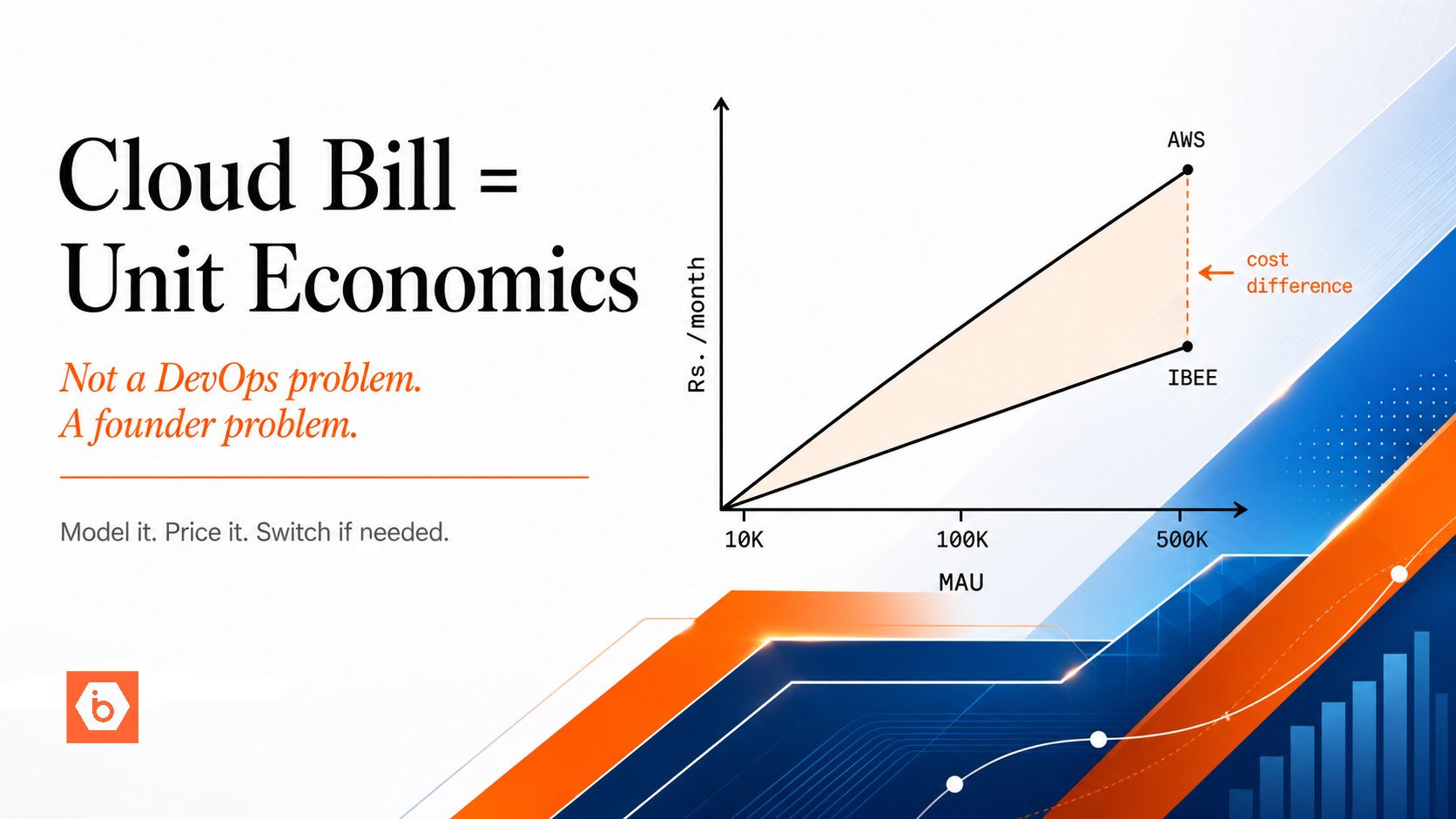

The Wrong Frame
Most startups discuss cloud costs in the engineering standup. The conversation is about which services are running, which Lambda functions are over-invoking, whether object storage lifecycle policies are configured correctly. It is a useful conversation. It is also the wrong frame for the real problem.
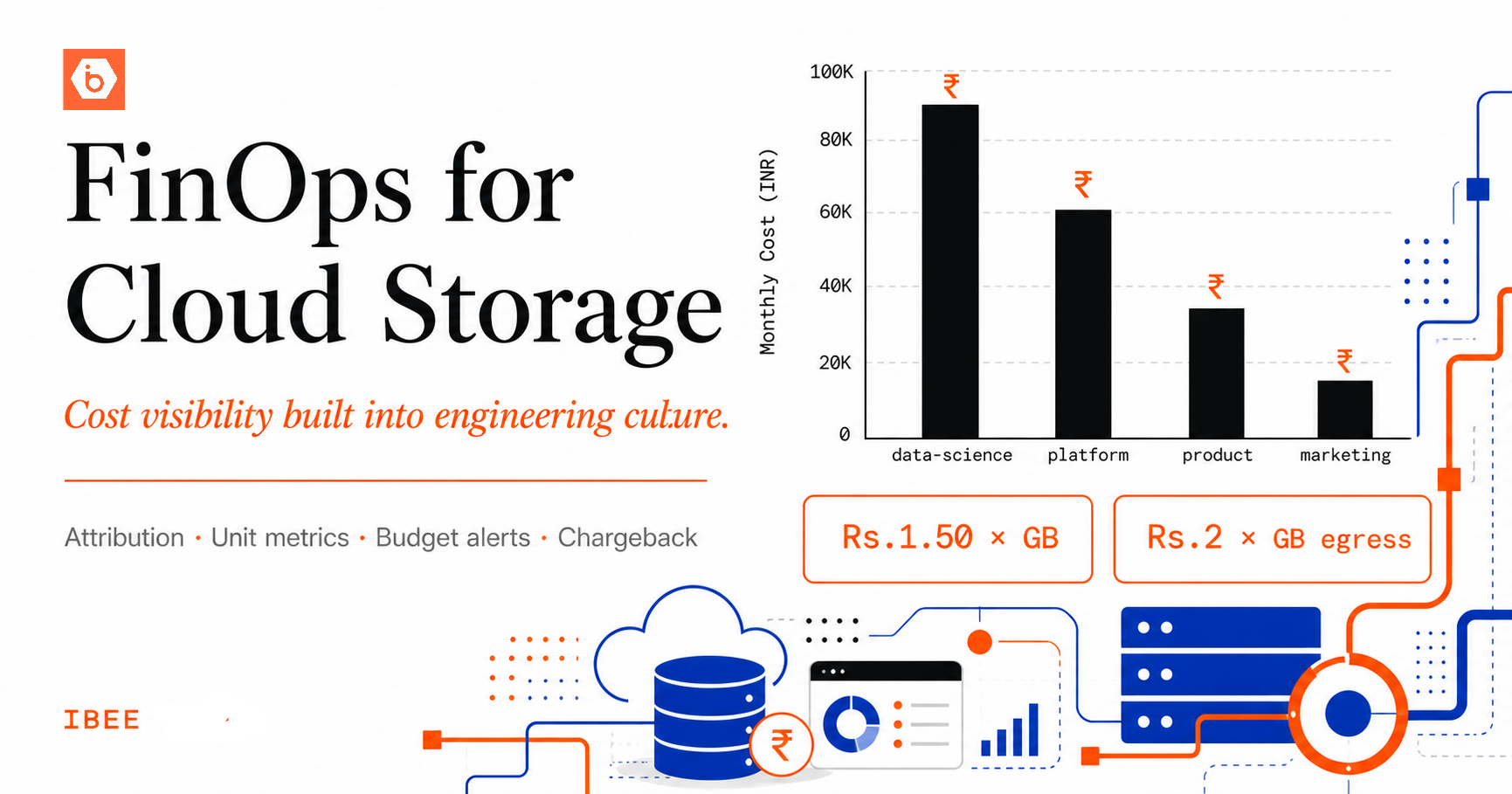
Cloud costs are a unit economics variable. Specifically, for any startup where the product delivers files, media, or data to users, the storage and egress cost per monthly active user is as important to understand and model as customer acquisition cost, support cost per ticket, or hosting cost per transaction.
When a Series A investor asks what it costs to serve one customer, the answer should include the cloud infrastructure cost attributed to that customer. For most Indian startups, it does not, because cloud costs live in DevOps, not in the unit economics model. This leads to two problems: the costs are not optimised at the right level, and they are not visible to the people making pricing and growth decisions.
The Model: Cloud Cost Per Monthly Active User
The calculation is not complicated. It requires three inputs: storage per user, egress per user per month, and the prices you are paying for each.
Storage per user is how much data one average user generates or requires. For an edtech platform, it is the course content they access plus any uploads. For a D2C platform, it is product images, invoices, and order documents. For a SaaS platform, it is attachments, exports, and generated reports.
Egress per user per month is how much data your product transfers to one average user in a month. For a video platform, it is hours watched multiplied by bitrate. For a document platform, it is downloads per month multiplied by average file size. For an image-heavy product, it is page views multiplied by image payload per page.
The third input is the price per GB, covering both the storage rate and the egress rate, which vary significantly between providers.
With these three numbers, you can calculate the cloud infrastructure cost per MAU and model how it behaves as you scale to 10,000, 100,000, and 1,000,000 users. We have spoken with founders who discovered this calculation only when their Series A investors asked about unit economics, at which point the egress line item had grown large enough to require explanation rather than just correction.
Why the Egress Rate Is the Most Important Number
Storage prices across cloud providers are within 20 to 30 percent of each other. The difference between Rs.1.50/GB/month ($0.016/GB/month) and Rs.1.90/GB/month matters at scale, but it is manageable.
Egress prices are not within 20 to 30 percent of each other. IBEE charges Rs.2/GB ($0.021/GB). AWS Mumbai charges Rs.10.37/GB ($0.1093/GB). That is a 5.2x difference on the variable that scales directly with your user base.
For a startup where each MAU generates 500 MB of monthly egress, the cost per user is Rs.1 on IBEE and Rs.5.19 on AWS. That difference is invisible at 1,000 users. At 100,000 users, it is Rs.4.19 lakh (~$4,417) per month, every month, compounding with every user you add.
For a startup where each MAU generates 2 GB of monthly egress, a video or audio platform, a design tool, or a heavy-media product, the cost per user on AWS Mumbai is Rs.20.74. On IBEE it is Rs.4. At 50,000 MAU, the difference is Rs.8.37 lakh (~$8,818) per month.
The table below shows how the monthly egress cost and saving scale across common egress profiles and MAU milestones.
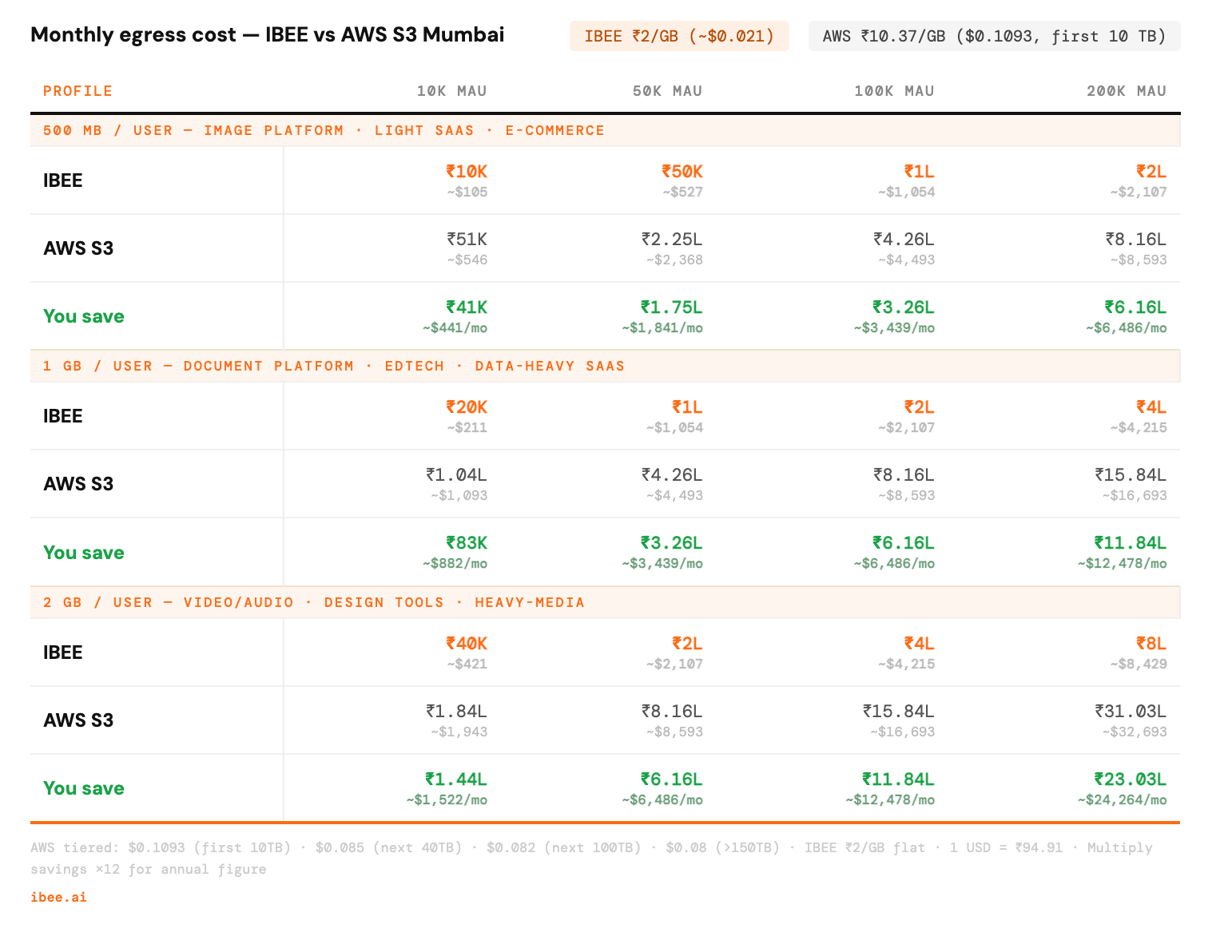
The cost difference is invisible at early scale and structural at growth scale.
Building the Model in Practice
Take your product. Identify the top three user actions that generate egress: the things users do most often that involve data leaving the cloud. For most products this is viewing images, downloading files, streaming media, or loading data-heavy pages.
Estimate the average payload per action. Multiply by monthly action frequency per user. That is your egress per MAU per month.
Now multiply by your provider's egress rate and by your projected MAU at 6, 12, and 24 months. The number you get is the cloud infrastructure cost ceiling for your storage layer.
If that number is comfortable at your 24-month projection, your current provider is fine. If it is uncomfortable, if the cloud bill at scale would represent 10 percent or more of revenue, you have a provider problem, not an optimisation problem.
Optimisation reduces a Rs.10 lakh bill to Rs.8 lakh. Changing providers reduces it to Rs.3 lakh.
The Reinvestment Argument
The case for switching to a more cost-effective storage provider is not just about cutting costs. It is about what you do with the difference.
An Indian B2C startup with 200,000 MAU, each generating 1 GB of monthly egress, pays Rs.20.74 lakh (~$21,851) per month on AWS S3 Mumbai. The same workload on IBEE costs Rs.4 lakh (~$4,214) per month. The Rs.16.74 lakh (~$17,637) monthly difference, annualised, is approximately Rs.2.01 crore (~$211,200). For most early-stage Indian startups, that is a meaningful sum: enough to extend runway significantly, fund a content or growth budget, or reinvest in product.
Cloud cost is not a small number at startup scale. Treating it as a unit economics variable, and making the provider decision accordingly, is one of the highest-leverage cost decisions a founding team can make before Series A.
What to Do With the Model
Once you have the cost-per-MAU number and the 24-month projection, there are three possible outcomes.
The numbers are fine and you stay with your current provider, because the cost is proportionate to revenue and the switching cost is not worth it.
The numbers are borderline and you implement lifecycle policies, compression, and CDN caching to reduce egress volume, which is the optimisation path.
The numbers are structurally problematic, meaning the cloud bill at scale would compress margin unacceptably, and you migrate to a lower-cost provider before the scale makes migration more expensive.
For most Indian startups building data-intensive products for Indian users, the honest answer to this analysis is the third option. The egress rate gap between hyperscalers and regional alternatives like IBEE is large enough that no amount of optimisation fully closes it.
IBEE for Startup Unit Economics
IBEE's pricing is simple enough to model in a spreadsheet: Rs.1.50/GB/month ($0.016/GB/month) for storage, Rs.2/GB ($0.021/GB) for egress, ingress free. No tiers, no storage classes, no minimum commitments. The number you calculate in the model is the number you pay.
For founders who want to run the numbers before committing, IBEE's permanent free tier covers 25 GB storage and 50 GB egress per month with no expiry and no payment method required. Build your MVP, validate your data transfer profile, and then scale on predictable pricing.