

The Default Is Not the Safe Choice
When an Indian startup's first engineer spins up cloud infrastructure, the path of least resistance leads to AWS. It is what the tutorials use. It is what the senior engineers at the last company used. It is what the accelerator's AWS credits are for. It feels like the safe, professional choice.
It is not the safe choice. It is the default choice. Those are different things.
The default choice is made without evaluating cost structure, egress model, data residency obligations, or how the pricing compounds as the product scales. The safe choice is made by understanding what you are signing up for and whether it matches the economics of your specific business.
For a SaaS startup processing 10 GB of data per month, the difference between hyperscaler and regional cloud pricing is noise. For a startup in media, edtech, healthtech, or e-commerce, where the product is delivering files, videos, documents, or images to Indian users at scale, the difference between AWS egress pricing and a sensible regional alternative is the difference between an infrastructure bill that scales with revenue and one that scales ahead of it.
What Most Founding Teams Get Wrong About Cloud Costs
Cloud costs have a shape that is not obvious from the pricing page. The storage price is what you see. The egress price is what will surprise you.
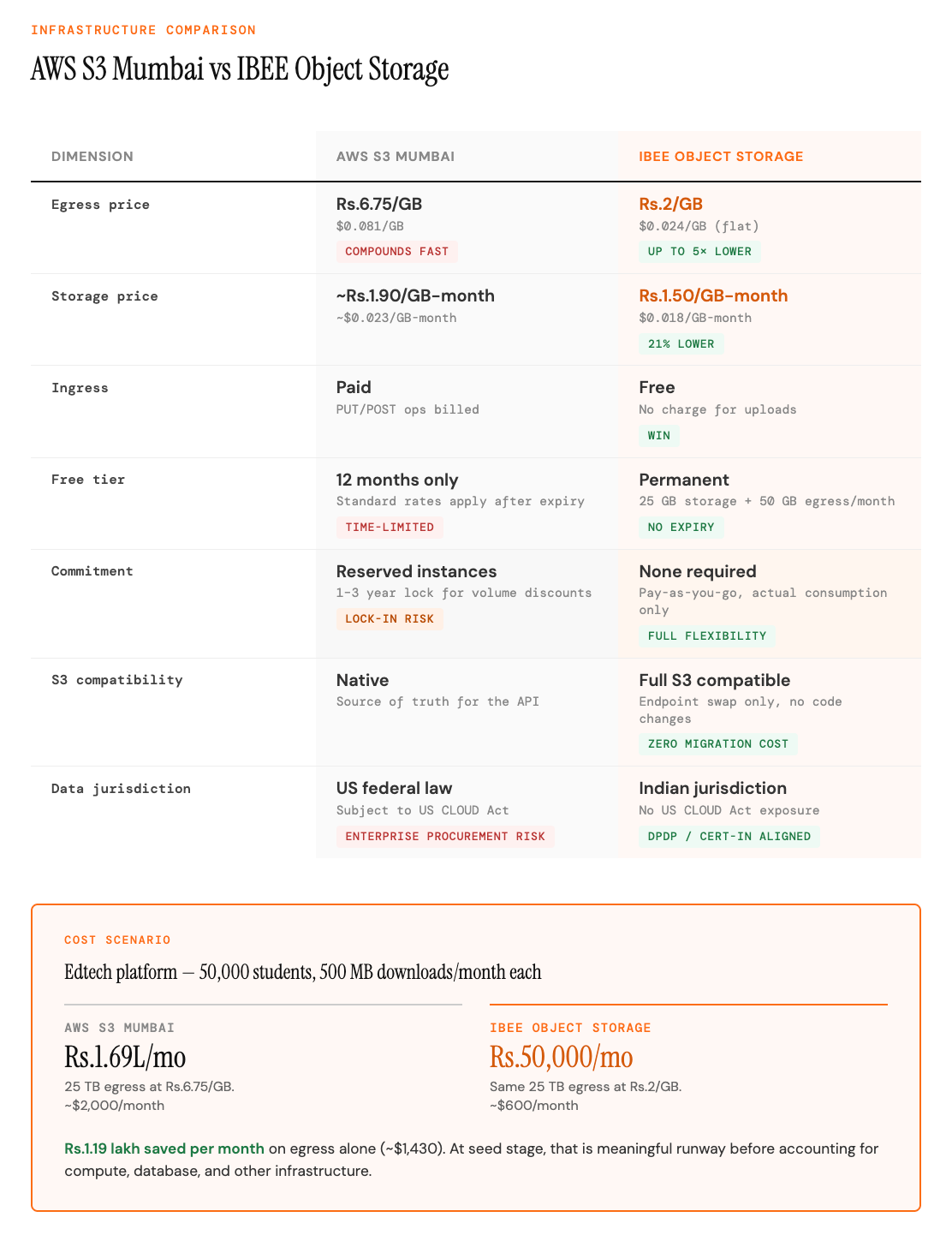
Storage is predictable. You upload 1 TB, you pay for 1 TB. The number is easy to model. AWS S3 Mumbai charges approximately Rs.2.37/GB-month (~$0.025/GB-month). IBEE charges Rs.1.50/GB-month ($0.016/GB-month). The gap is real but not catastrophic at early scale.
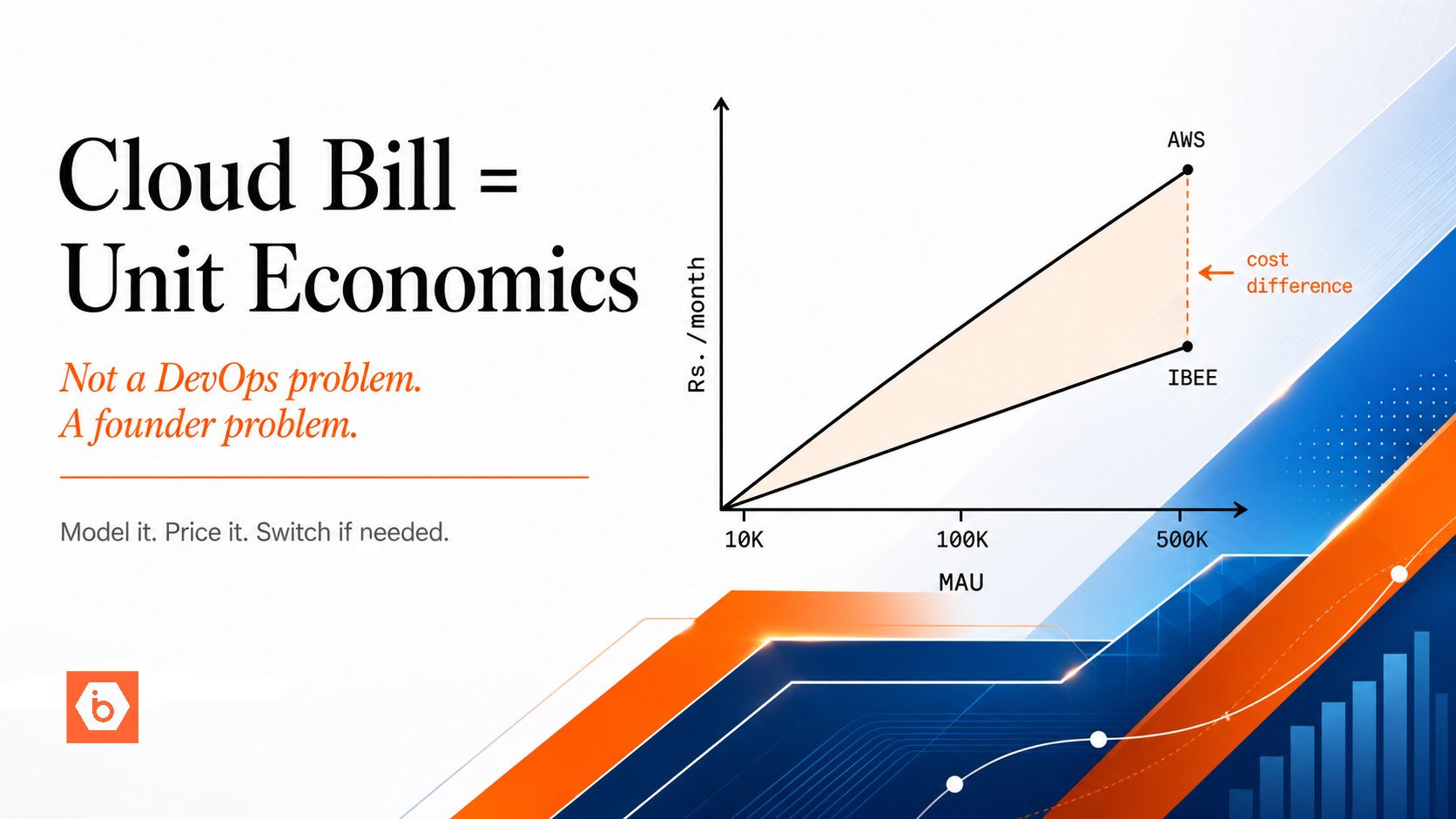
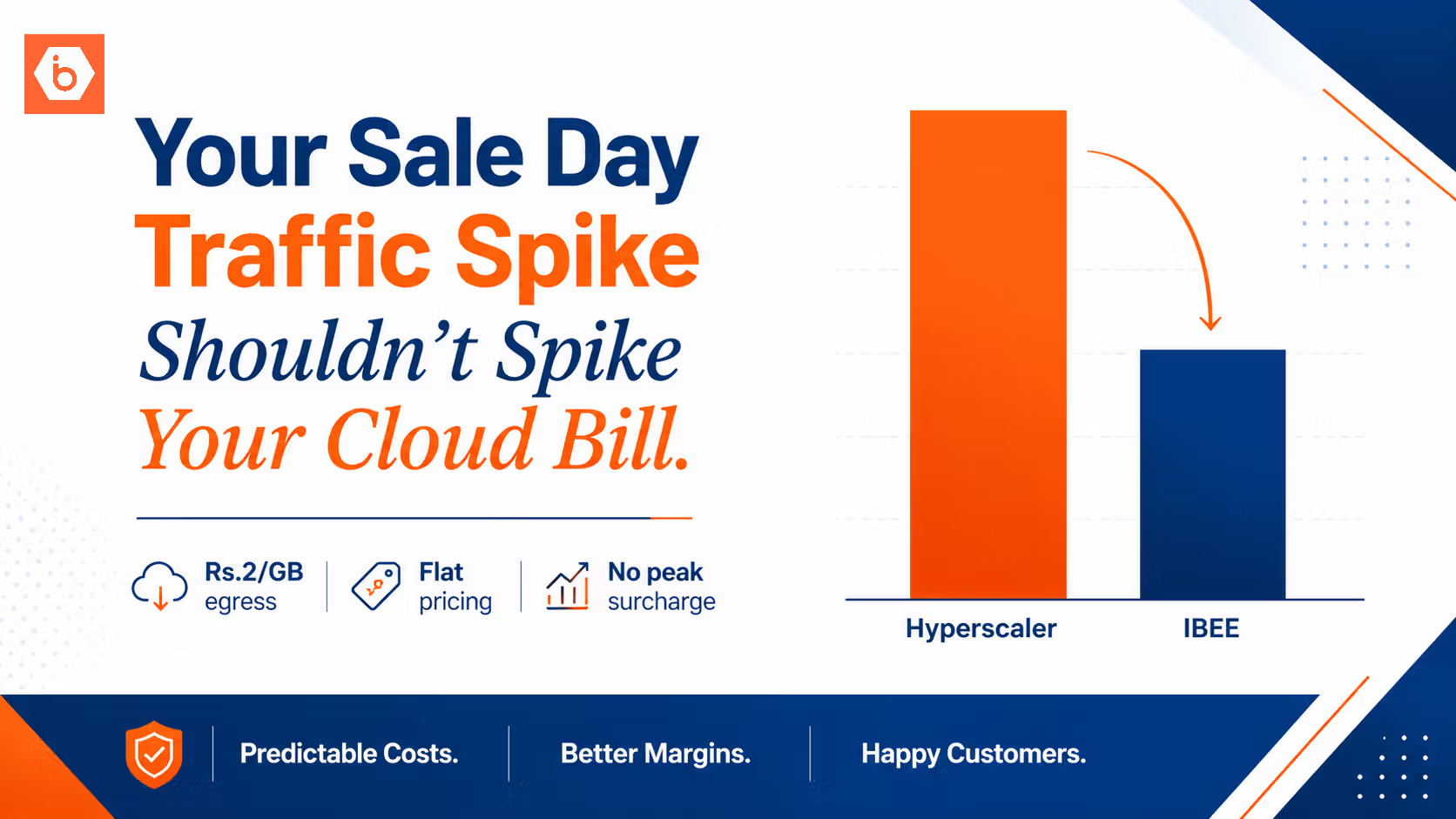
Egress is where the model breaks. Every time your product delivers a file to a user, a video, a PDF, a product image, an audio clip, a report download: data leaves the cloud. On AWS Mumbai, that costs Rs.10.37/GB ($0.1093/GB). On IBEE, it costs Rs.2/GB ($0.021/GB). All USD equivalents in this article use a conversion rate of Rs.94.91 per dollar as of May 2026. For a product that serves Indian users at any kind of scale, this is not a minor optimisation. It is a structural cost difference that compounds with every user you add.
An edtech startup with 50,000 students downloading an average of 500 MB of content per month is generating 25 TB of monthly egress. At AWS rates, that is approximately Rs.2.59 lakh per month (~$2,728) in egress alone, before any compute, database, or other infrastructure costs. At IBEE rates, it is Rs.50,000 (~$527).
The Rs.2.09 lakh (~$2,201) monthly difference, at seed stage, is meaningful runway.
We have seen this pattern more than once: a startup reaches 20,000 monthly active users, the infrastructure bill triples in a single month, and the team realises the egress model was never part of the original cost evaluation.
Four questions to evaluate in order before committing to a cloud provider at seed stage.
The Five Infrastructure Decisions That Compound
1. Which Cloud to Use for Object Storage
Object storage is where most startup egress costs live. Images, videos, documents, backups, user uploads: all of it flows through your object storage bucket. The provider you choose here determines the egress rate you pay for the life of the product.
The question to ask is not which cloud is most popular but how much data your product moves per user per month and what that costs at scale on each platform you are evaluating. For most Indian startups serving Indian users, the answer to this calculation favours regional cloud providers over hyperscalers, sometimes dramatically.
2. Commitment vs Pay-as-You-Go
Hyperscalers offer significant discounts for reserved capacity: committed use discounts, savings plans, reserved instances. The discounts are real. The commitment is also real. A one-year reserved instance commitment made at seed stage, based on traffic projections that turn out to be wrong, is capital locked into infrastructure you may not need.
IBEE has no minimum commitment and no reserved capacity model. You pay for what you use, billed on actual consumption. For a startup where traffic patterns are still being discovered, this flexibility has real economic value.
3. Data Residency Early
Startups building in healthtech, fintech, edtech serving regulated institutions, or any product with government or enterprise customers will face data residency questions at Series A fundraising or when closing their first enterprise contract, whichever comes first.
The question will be: where does your users' data live, and under what legal jurisdiction? If the answer is AWS Mumbai, which is operated by a US company under US federal law, some enterprise procurement teams and most government clients will require a migration before they proceed. This applies beyond India as well. GDPR in Europe, HIPAA in the United States, and national data sovereignty frameworks in the Middle East and Southeast Asia all create similar pressure for jurisdiction clarity at the enterprise sales stage.
We have spoken with founding teams who lost procurement approvals because a customer's legal review flagged US data jurisdiction as a blocker. Building on India-sovereign infrastructure from the start removes that category of risk entirely.
4. Vendor Lock-in Surface Area
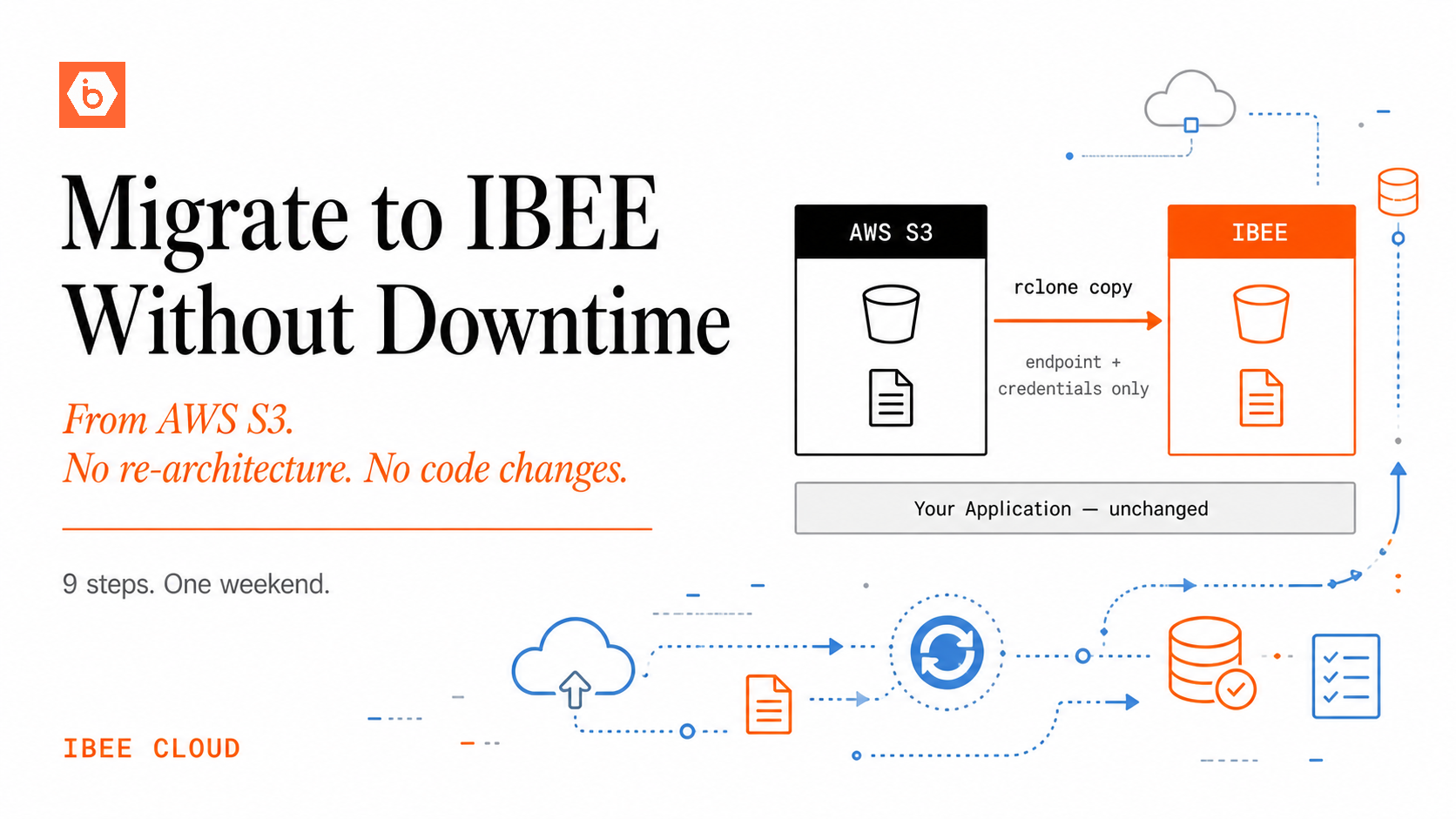
AWS's object storage SDK, proprietary database services, Lambda, API Gateway: the more AWS-specific services a seed-stage startup uses, the larger the migration cost if they ever need to move. S3-compatible object storage is the lowest lock-in surface area in the stack. Any provider that supports the S3 API is a configuration change away, not a re-architecture.
IBEE's full S3 compatibility means an application built against IBEE can be pointed at AWS S3 by changing an environment variable. The reverse is also true. You are not locked in.
5. Free and Trial Tiers
IBEE's permanent free tier provides 25 GB of storage and 50 GB of egress per month with no expiry and no payment method required. For a startup in pre-product or early MVP stage, this means zero infrastructure cost on the storage layer until actual user scale justifies it.
AWS's free tier is 12 months only, after which standard rates apply regardless of whether the product has reached revenue.
A Framework for the Decision
When evaluating cloud infrastructure at seed stage, four questions determine the right choice.
The first is your data transfer profile. How much data does your product deliver to users per monthly active user? Multiply by your 12-month user projection. This gives you the egress volume. Multiply that by the egress rate on each platform you are evaluating. The number you get is your infrastructure cost ceiling, and it is the single most important figure in this decision for any product that moves files.
The second is whether your sector has data residency requirements. Healthtech, fintech, edtech with institutional clients, and government-facing products all have either current or near-future data residency obligations, under Indian frameworks such as DPDP and CERT-In guidelines as well as global frameworks including GDPR and HIPAA. Building on India-sovereign infrastructure from day one means you never have to answer this question under deadline pressure.
The third is how much flexibility you need. If traffic projections are uncertain, avoid long-term commitments. The flexibility premium on pay-as-you-go pricing is worth it at early stage when your usage model is still being validated.
The fourth is the migration cost if you get this wrong. Low lock-in means a wrong decision is recoverable cheaply. High lock-in means a wrong decision becomes expensive at the worst possible time, when you are growing and every engineering hour matters.
[IMAGE PLACEHOLDER: seed_stage_infra_decision_framework] — Four questions to evaluate in order before committing to a cloud provider at seed stage.
What IBEE Provides for Early-Stage Startups
IBEE's Tier 4 data centres provide the same infrastructure reliability, 99.995% uptime, that large enterprises pay significant premiums for on hyperscalers. For an early-stage startup, that reliability tier comes with a pricing model designed for the Indian market rather than for global enterprise software companies.
Storage is Rs.1.50/GB-month ($0.016/GB-month). Egress is Rs.2/GB ($0.021/GB). Ingress is free. There is no minimum commitment and no reserved capacity requirement. Full S3 API compatibility means zero re-architecture cost for applications already built against any S3-compatible provider. Support is 24/7 from an India-based team in IST. Data is stored under Indian jurisdiction with AES-256 encryption at rest and TLS 1.3 in transit, both on by default, with 180-day audit log retention and no US CLOUD Act exposure.
The case for IBEE at seed stage is not that it is exotic or contrarian. It is that it is the sensible choice for Indian startups building products for Indian users, and that the startups who figure this out early do not have to figure it out later under pressure.
Getting Started
IBEE's S3-compatible API means any existing application built for AWS S3 works with IBEE by changing the endpoint URL and credentials. For greenfield projects, the setup time is the same as any S3-compatible storage provider.