
The Problem With "Infrastructure" as a Cost Category
When cloud storage costs are tracked as a single line item called "infrastructure," nobody owns them. The engineering team sees a number that grows each month. Finance sees the same number. Neither team knows which product, team, or feature is driving the growth, and therefore neither team can make a specific decision to reduce it.
FinOps for cloud storage is the practice of turning an opaque infrastructure line item into a set of attributable, actionable metrics. The goal is not to hire a FinOps team. It is to make storage costs legible to the people making product and architecture decisions. The same discipline applies whether your team is based in India, Southeast Asia, or Europe, where the underlying problem of unattributed infrastructure cost is universal.
Step 1: Tagging for Attribution
The foundation of cloud cost attribution is resource tagging. Every storage bucket should carry at minimum three tags: an owner team, a product or service name, and an environment label such as production, staging, or development.
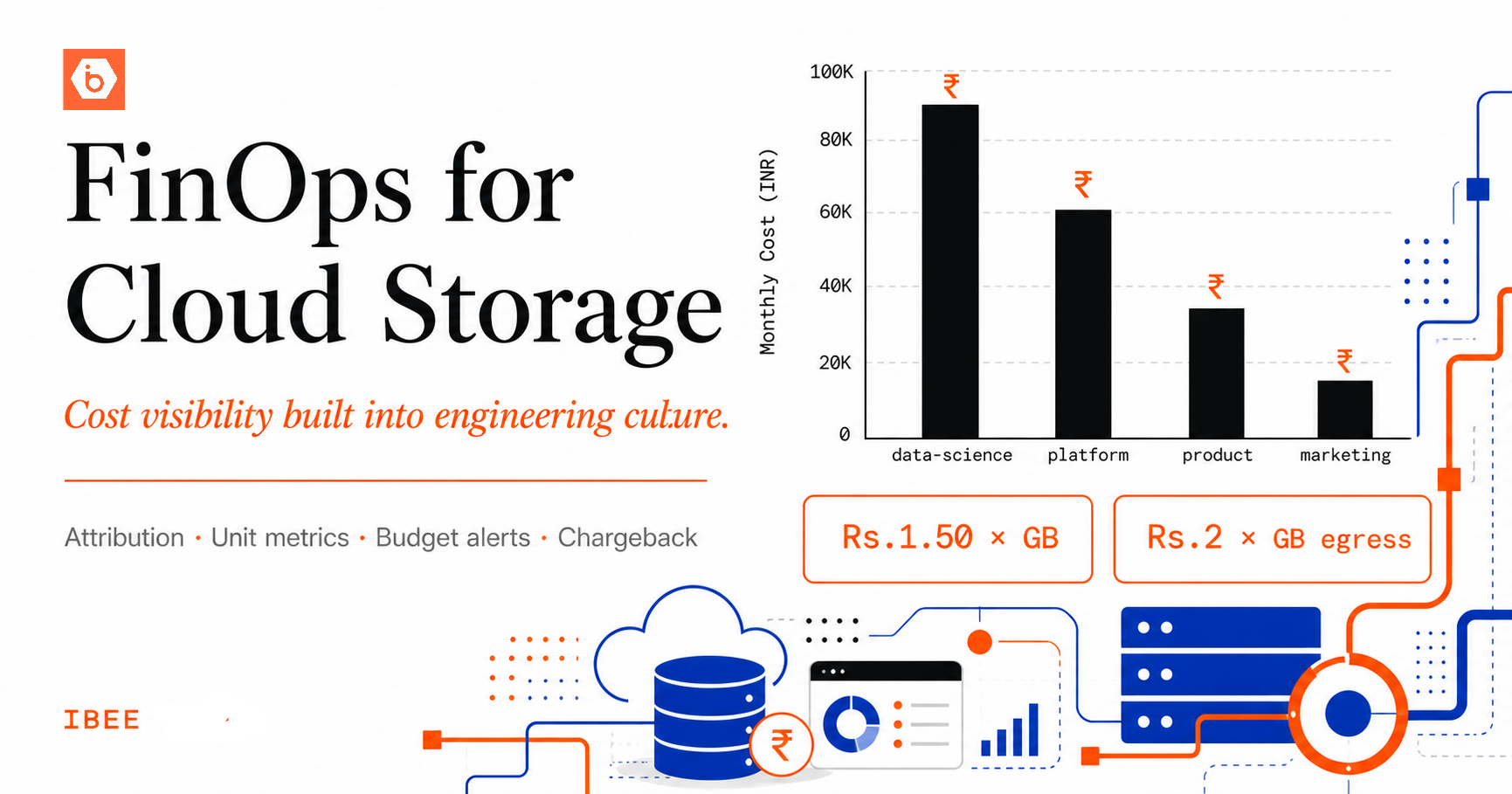
On AWS, tag-based cost allocation is enabled through the Billing console's Cost Allocation Tags feature. Once enabled, Cost Explorer shows storage costs broken down by tag value, making it possible to see, for example, that the data-science team's buckets account for Rs.45,000 (~$474) of the month's storage costs while the product team's buckets account for Rs.1.2 lakh (~$1,265). All USD equivalents in this article use a conversion rate of Rs.94.91 per dollar as of May 2026.
On IBEE, the equivalent mechanism is consistent bucket naming that encodes owner and purpose directly. A bucket named after its owning team and workload, such as platform-uploads-prod or datascience-models-staging, carries attribution in the name itself. In the absence of tag-based billing, naming convention is the attribution mechanism, and it works provided the convention is applied consistently from the start.
The practical rule is that no bucket should be created without a documented owner. Making this a checklist item on any infrastructure pull request is the lowest-friction way to enforce it.
Step 2: Cost-Per-Unit Metrics
Once costs are attributed to teams and products, the next step is connecting them to product metrics. A raw cost in rupees is less useful than a cost per unit of product output.
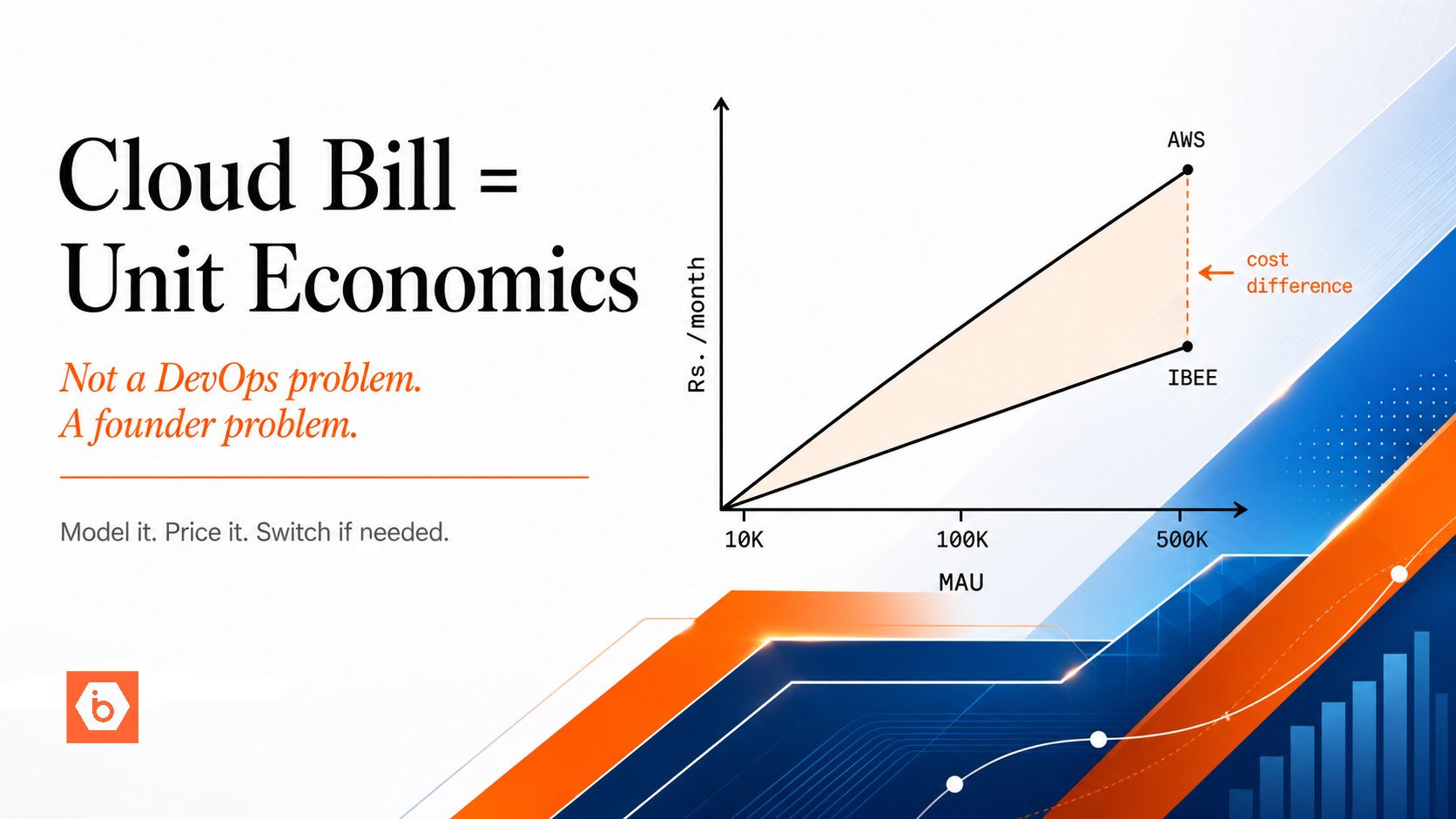
For a user-facing product, the relevant metric is storage and egress cost per monthly active user. For a B2B SaaS platform, it is storage cost per customer account. For a media platform, it is egress cost per hour of content streamed. Calculate this monthly and track it alongside other unit economics metrics. A rising cost per MAU while revenue per MAU holds flat is a signal worth investigating. A falling cost per MAU as the product scales is evidence that infrastructure decisions are working.
The cost-per-unit metric connects infrastructure spend to product decisions in a way that the total bill does not. An engineer proposing a feature that doubles user uploads per session can estimate its storage cost impact in concrete terms. A product manager can weigh the feature's value against its infrastructure cost before the code is written. We have seen teams make meaningfully different architecture choices once this calculation became part of their standard feature estimation process.
Step 3: Budget Alerts and Anomaly Detection
Storage costs should not be reviewed only at month-end billing. Budget alerts that trigger when daily or weekly storage spend exceeds a threshold catch problems early. On AWS, Budget Alerts in Cost Explorer deliver notifications by email or SNS. On IBEE, usage can be monitored through the dashboard or API at any interval the team chooses.
Anomaly detection looks for unexpected spikes: a day where egress runs at five times its normal level because a misconfigured process started reading a public bucket repeatedly, or a week where storage growth accelerated because a pipeline wrote data to an unintended prefix without a lifecycle policy in place. Catching these in days rather than weeks reduces the remediation cost proportionally. The monitoring configuration approach for IBEE buckets is documented at ibee.ai/docs.
Step 4: Monthly Cost Review as an Engineering Ritual
A 30-minute monthly storage cost review with the engineering lead responsible for infrastructure makes cost trends visible before they become large enough to require emergency action. The agenda is straightforward: which buckets grew, which teams are above their cost-per-unit targets, and what actions were taken since the last review.
This is not a blame meeting. It is a visibility meeting. The outcome should be a short written record covering what the bill was, what changed from the previous month, and what the planned actions are. After three to four months, that record becomes a history of which interventions worked and what the cost trajectory looks like over time.
Step 5: Chargeback or Showback to Product Teams
For organisations where multiple product teams share cloud infrastructure, chargeback (billing each team for their actual usage) or showback (presenting each team with their attributed costs without raising an internal invoice) creates accountability at the team level.
With bucket naming or tagging in place, the monthly attribution report is straightforward: each team's share of storage and egress costs, expressed in rupees, linked to the resources they own. Showback is typically less contentious than chargeback. Teams see what they cost without facing an internal invoice, but the visibility still creates the incentive to own their data lifecycle, remove unused buckets, and consider the egress impact of new features before shipping them.
How IBEE Simplifies the FinOps Calculation
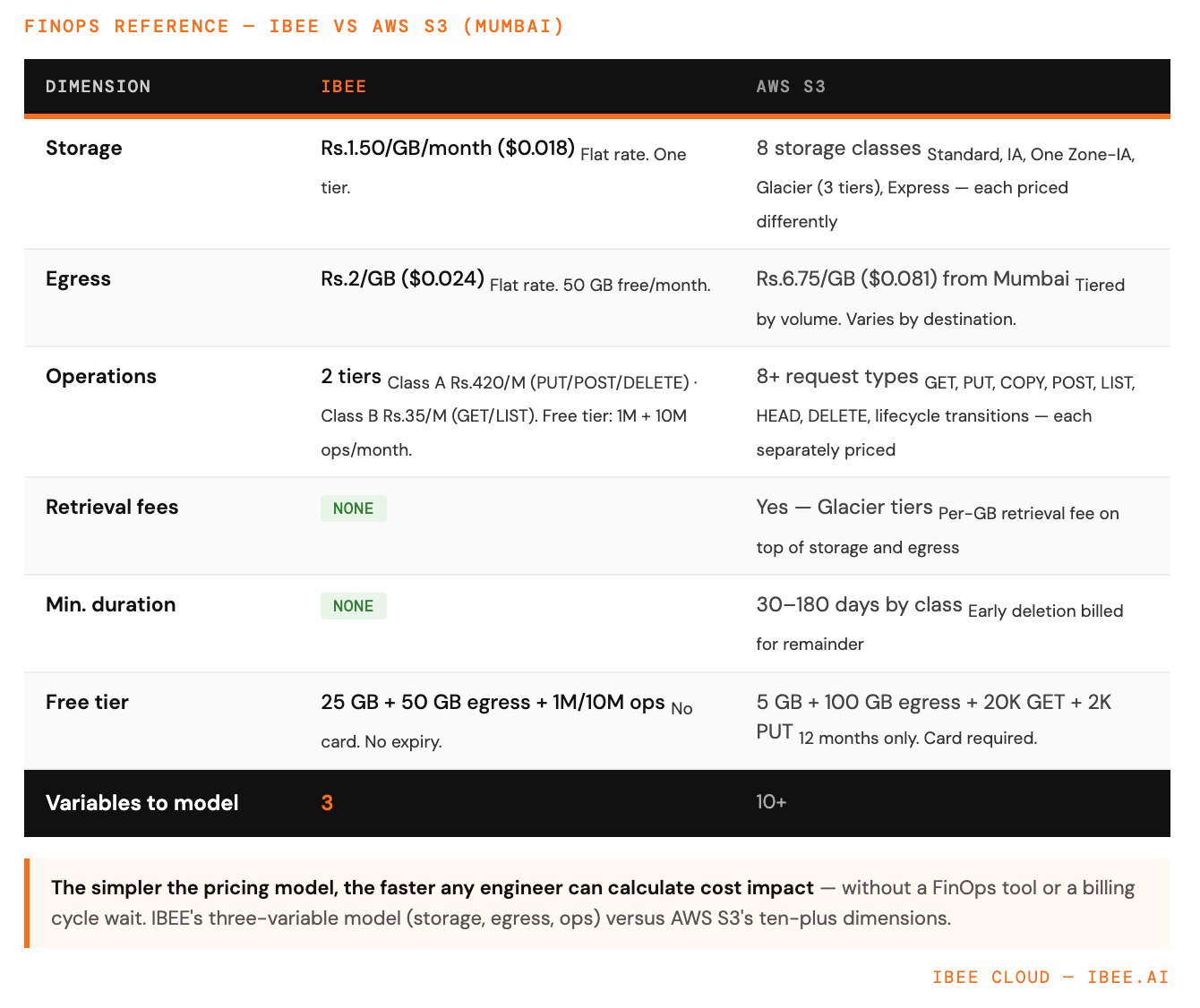
FinOps calculations become harder when the pricing model itself is complex. The table below illustrates the difference in the number of dimensions a team must track when modelling storage costs on IBEE versus a large hyperscaler.
Fewer variable, Faster cost calculation
IBEE's pricing is built on three clearly defined variables: storage at Rs.1.50/GB/month ($0.016/GB/month), egress at Rs.2/GB ($0.021/GB), and request operations in two tiers (Class A at Rs.420/million for write operations including PUT, POST, and DELETE; Class B at Rs.35/million for read operations including GET and LIST). The cost model is a multiplication table. Any engineer can calculate their team's expected storage cost from first principles in five minutes, without a FinOps tool or specialist knowledge. The simplicity of the model is itself a FinOps benefit: it means the cost impact of any product decision is always calculable, which is the precondition for making cost a first-class consideration in engineering decisions rather than an afterthought discovered at month-end.