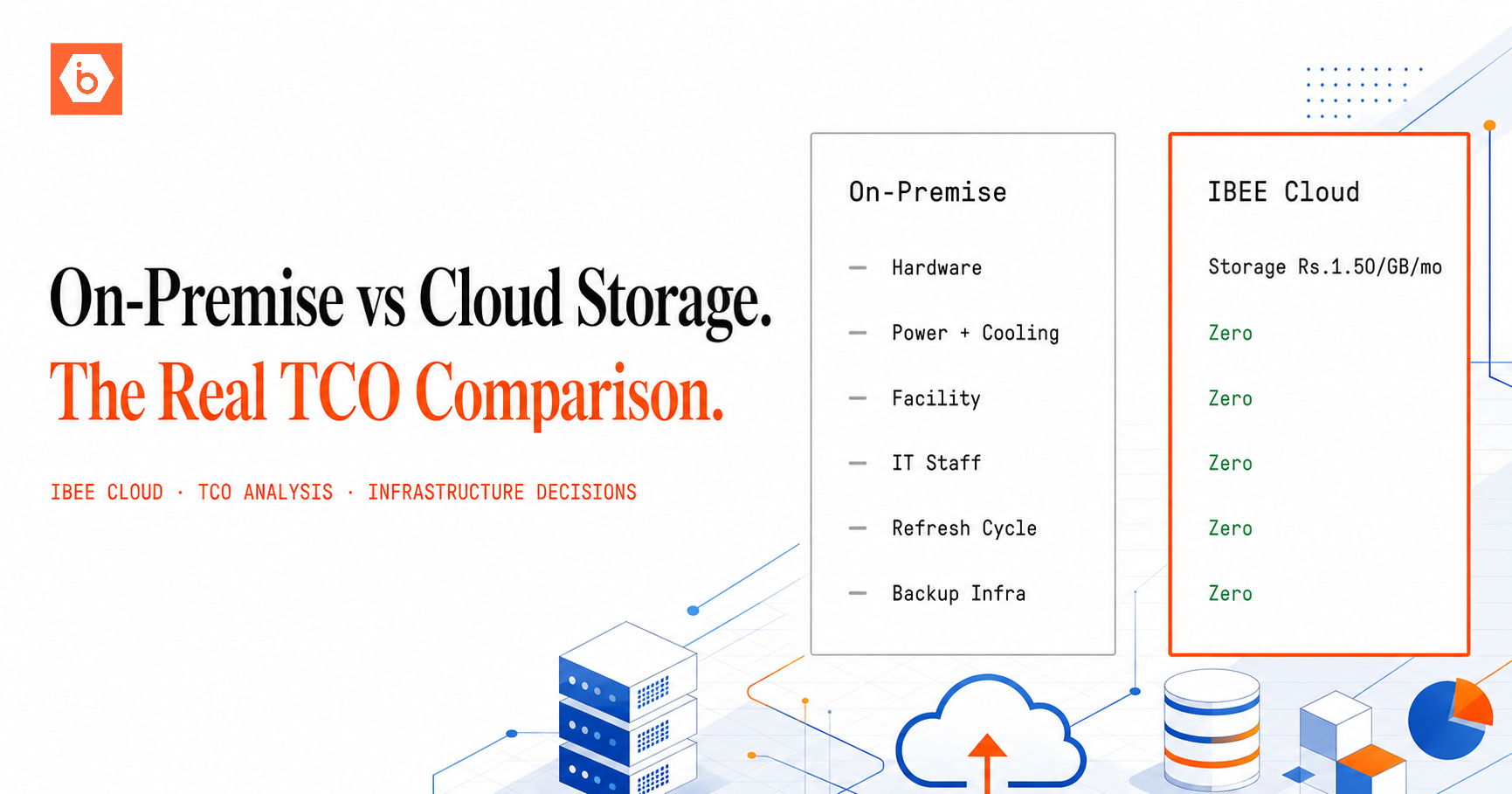

The Illusion of On-Premise Cheapness
On-premise storage infrastructure feels like it should be cheaper than cloud. You buy the hardware once. You own it. You are not paying a monthly bill to a cloud provider indefinitely.
This reasoning is correct about one thing: the hardware cost is a one-time purchase. It is incorrect about everything else. On-premise storage has a set of costs that do not appear on the hardware invoice and rarely get included in informal TCO comparisons. When they are included, the picture changes significantly.
This comparison does the full TCO calculation for a representative mid-size business running approximately 100 TB of active storage, and identifies where the break-even points between on-premise and cloud storage actually are. The numbers use Indian pricing as a concrete reference point — INR rates are noted alongside USD equivalents throughout so the analysis is applicable to any market.
The On-Premise Cost Model
Hardware acquisition is the most visible cost and the one that anchors the mental model of on-premise cheapness. A modern NAS or SAN system with 100 TB of usable capacity from a reputable vendor costs approximately Rs.15 to 25 lakh ($18,000 to $30,000) for hardware alone. This excludes networking equipment, rack space, power distribution units, and UPS systems.
Hardware refresh cycles are the first hidden cost most teams forget. Enterprise storage hardware has a practical lifecycle of three to five years before it requires replacement, whether due to end-of-support on the platform, capacity requirements that exceed what the existing system can handle, or reliability concerns as drives age. At a four-year refresh cycle, the annual amortised hardware cost for a Rs.20 lakh ($24,000) system is Rs.5 lakh ($6,000) per year.
Power and cooling add up faster than most estimates account for. A 100 TB storage system with associated networking draws roughly 2 to 3 kW continuously. At commercial power rates, this costs approximately Rs.14,000 to 22,000 ($165 to $260) per month in power alone, or Rs.1.7 to 2.6 lakh ($2,000 to $3,100) per year. Cooling to maintain the server room at appropriate temperatures for electronic equipment adds another 30 to 50 percent to the power cost.
Facility cost is often the largest hidden expense and the one most frequently excluded from on-premise TCO calculations. If the storage lives in a dedicated server room within the office, the proportionate facility cost — rent, maintenance, and physical security for the server room square footage — needs to be allocated. In major business districts across Asia, Europe, or North America, dedicated server room space is expensive relative to its footprint.
IT staff time is the most consistently underestimated cost. Someone on the team manages the storage infrastructure: firmware updates, drive replacements, capacity monitoring, backup verification, and incident response. Conservatively, one quarter of a mid-level IT engineer's time goes to storage infrastructure management. At typical compensation for that role in a mid-size business, the storage management allocation is Rs.3 to 4.5 lakh ($3,600 to $5,400) per year.
Backup infrastructure is an additional cost category entirely separate from primary storage. On-premise primary storage requires on-premise backup storage, off-site backup storage, or both. The backup layer is not included in the primary hardware cost.
Unplanned downtime has a real but difficult-to-quantify cost. On-premise storage systems fail. A RAID rebuild after a drive failure takes hours. A controller failure may take days to resolve if replacement parts are not immediately available. Each hour of storage downtime carries a business cost that does not appear anywhere on an infrastructure cost sheet.
The Full On-Premise TCO at 100 TB
Combining these cost categories for a 100 TB active storage deployment in a mid-size business, the annual on-premise TCO breaks down as follows. Hardware amortisation at a four-year refresh cycle: Rs.5 lakh ($6,000) per year. Power and cooling: Rs.2.5 to 4 lakh ($3,000 to $4,800) per year. Facility cost, proportionate allocation: Rs.2 to 8 lakh ($2,400 to $9,500) per year. IT staff time allocation: Rs.3 to 4.5 lakh ($3,600 to $5,400) per year. Backup infrastructure: Rs.1 to 3 lakh ($1,200 to $3,600) per year.
Total annual on-premise TCO: Rs.13.5 to 24.5 lakh ($14,224–$25,814) per year. On a per-GB basis this works out to approximately Rs.1.12 to 2.04 per GB per month ($0.013 to $0.024 per GB per month) on storage cost alone, before any egress costs for delivering data to users or external systems.
This excludes the cost of capital tied up in hardware that could otherwise be deployed in the business, and the opportunity cost of IT staff time spent on infrastructure management rather than product development.
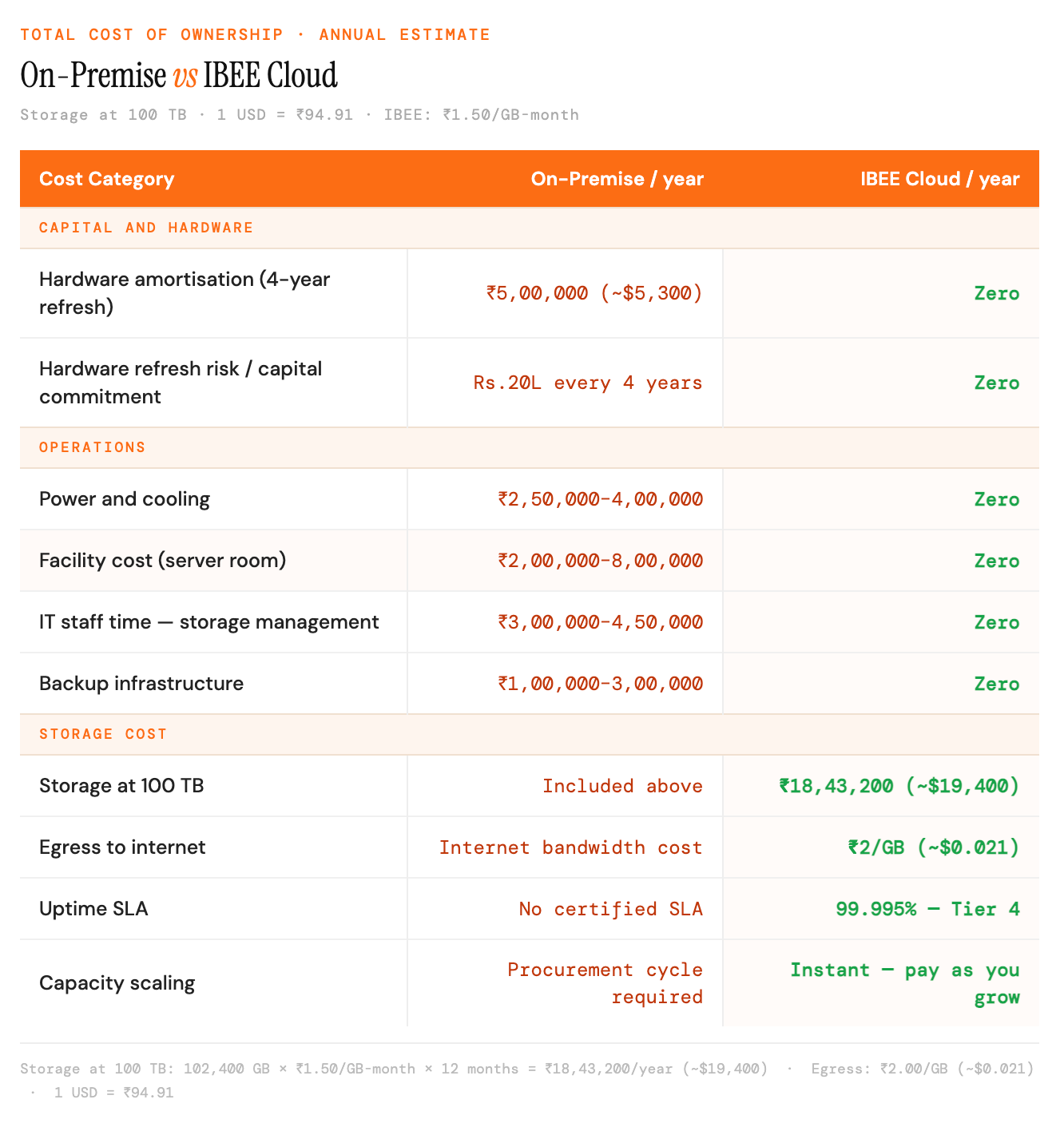
The hardware invoice is the smallest part of the on-premise cost picture.
The IBEE Cloud Storage Cost at 100 TB
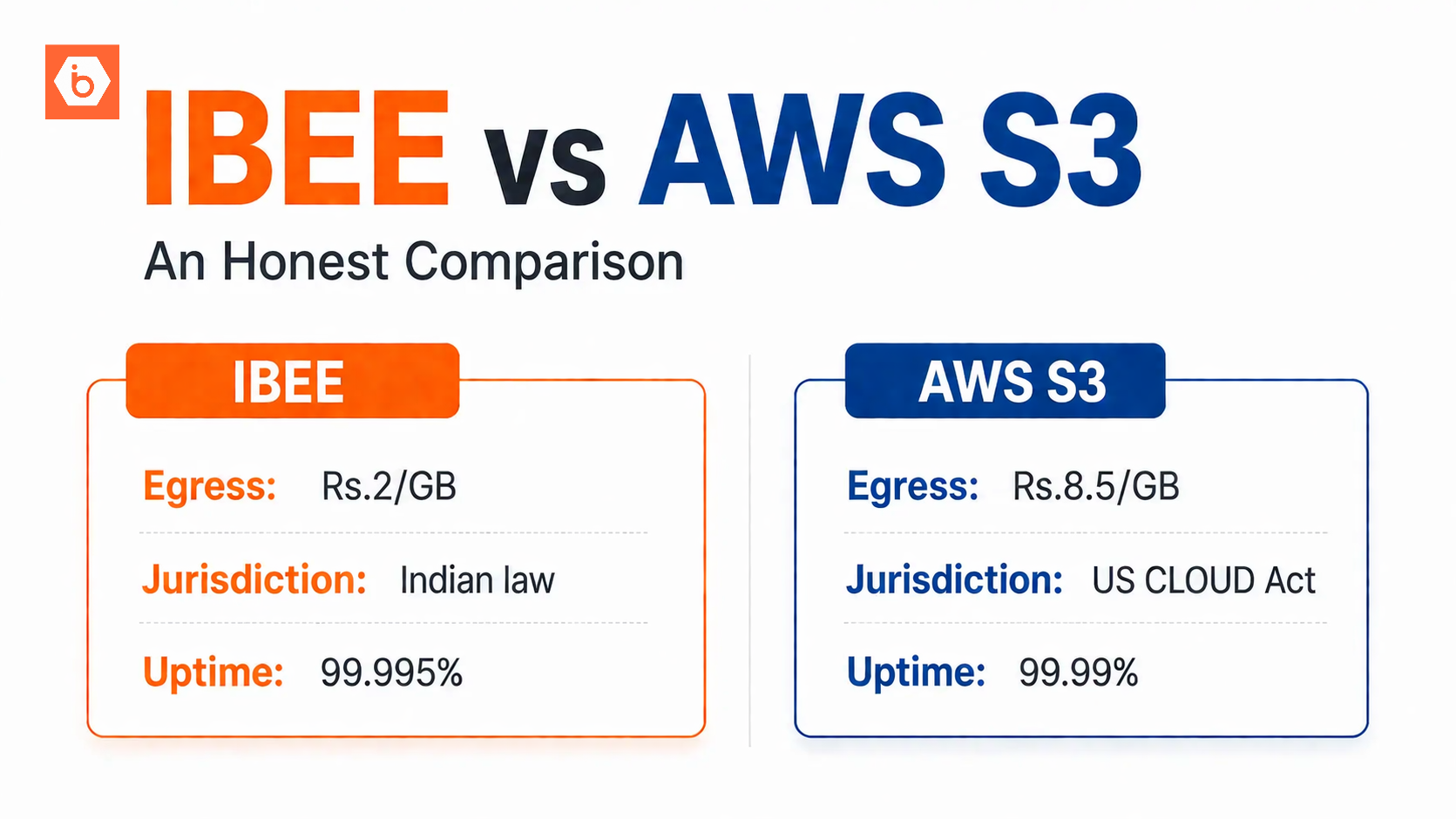
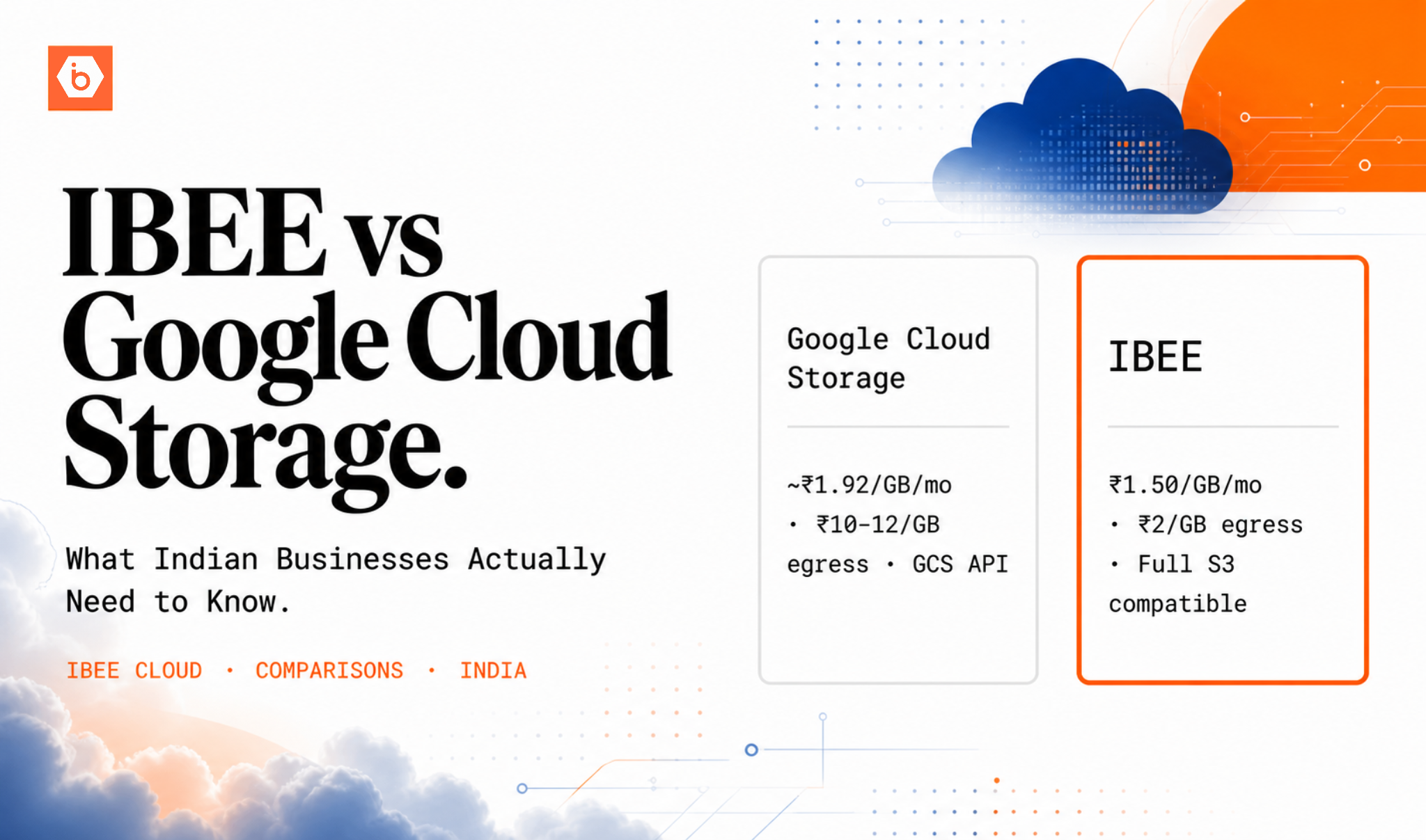
IBEE charges Rs.1.50 per GB per month ($0.018 per GB per month) for storage. At 100 TB using binary calculation (102,400 GB), that is Rs.1.54 lakh ($1,830) per month, or Rs.18.4 lakh ($21,900) per year.
Egress at Rs.2 per GB ($0.024 per GB) is an additional cost that on-premise storage also incurs in the form of internet bandwidth from the facility, but it is more directly visible on a cloud bill. For teams that want to model this honestly, include it in both the on-premise and cloud columns.
Beyond the storage line item, there are no hardware costs, no refresh cycles, no power and cooling expenses, no facility allocation, and no storage-specific IT staff time. IBEE's 24/7 support handles infrastructure incidents. Capacity scales without a procurement cycle or a capital commitment for anticipated future growth.
Where On-Premise Wins
For large-scale cold storage with high data volume and minimal egress requirements — bulk media archives, legal record repositories, regulatory data warehouses — on-premise can be cost-competitive when facility and power costs are already absorbed by other infrastructure and when data is infrequently accessed, which eliminates meaningful egress costs.
On-premise also wins when data cannot leave the facility for regulatory or security reasons. For certain government, defence, or classified data categories, air-gapped on-premise storage is not a cost decision — it is a compliance requirement that cloud storage cannot address by design.
Where Cloud Storage Wins
For active storage that serves users and applications — where data is regularly read, written, and delivered — cloud storage wins on every dimension except the per-GB storage price for very large, cold datasets.
Cloud storage scales elastically. There is no procurement cycle and no capital commitment for capacity needed three years from now. Storage grows with the business rather than ahead of it.
Cloud storage eliminates hardware refresh risk. There is no capital expenditure event in year four. The operational risk of hardware failure is absorbed by IBEE's infrastructure team rather than internal IT staff.
Cloud storage provides documented, independently certified uptime SLAs. IBEE's Tier 4 SLA of 99.995% is a level of reliability that self-managed on-premise infrastructure cannot match without a significantly higher infrastructure investment and independent Tier 4 certification.
The Break-Even Analysis
For a 100 TB active storage deployment, the cloud versus on-premise break-even depends on the specific facility and staffing situation. In most mid-size businesses, the full on-premise TCO of Rs.13.5 to 24.5 lakh ($16,000 to $29,000) per year is comparable to or higher than IBEE cloud storage costs of Rs.18.4 lakh ($21,900) per year for pure storage.
For businesses with already-amortised facility costs and low-cost power, on-premise may be marginally cheaper on a pure cost basis. The hidden costs that consistently tip the analysis toward cloud are operational complexity, hardware refresh capital, and the opportunity cost of IT staff time.
For growing businesses where storage requirements are increasing year over year, cloud storage's pay-as-you-grow model eliminates the capital risk of over-provisioning hardware for growth that may not materialise on the original schedule.
Migration Path From On-Premise to IBEE
For businesses with existing on-premise storage evaluating a migration, IBEE's full S3 API compatibility means standard migration tools work directly. Copy data from an on-premise NAS to IBEE buckets using rclone sync. Validate the copy against checksums. Update application configuration to point at the IBEE endpoint. Decommission the on-premise system at whatever pace the business requires. No code changes, no new SDKs, no vendor-specific migration tooling required.