For Indian businesses currently using or evaluating Google Cloud Storage as their primary object storage platform.
Google Cloud Storage: A Capable But Expensive Platform
Google Cloud Storage (GCS) is a mature, well-documented, globally available object storage platform. It is the natural choice for teams building on the Google Cloud Platform — particularly for workloads that integrate with BigQuery, Vertex AI, Dataflow, or other GCP-native data services. For those workloads, GCS is not just a storage option; it is the storage option, because the integration is native and often requires no additional configuration.
For Indian businesses using GCS as general-purpose object storage — file hosting, media delivery, user uploads, backups — without deep GCP service integration, the picture is different. GCS is expensive, uses a proprietary API, and carries the same US jurisdiction issues as other foreign-operated cloud platforms.
API and Compatibility
This is the first structural difference. Google Cloud Storage uses the GCS JSON API and XML API, which are not S3-compatible. Applications built for S3 do not work with GCS without SDK changes. The reverse is also true — applications built for GCS do not work with S3-compatible providers (including IBEE) without code changes.
GCS does offer an S3-compatible interoperability mode, but it has limitations and is not recommended for production workloads requiring full S3 feature parity.
IBEE is fully S3-compatible. Applications written against AWS S3 work on IBEE by changing endpoint and credentials. Applications written against GCS require an SDK change to move to IBEE (or to any S3-compatible provider).
The API lock-in factor is relevant for businesses evaluating GCS as a new storage choice — committing to GCS means committing to the GCS SDK in your application code, which increases migration cost if you ever need to move.
Pricing Comparison
GCS Mumbai region pricing (Standard storage class): approximately $0.023/GB-month, which at current INR rates is roughly Rs.1.92/GB-month. IBEE charges Rs.1.50/GB-month.
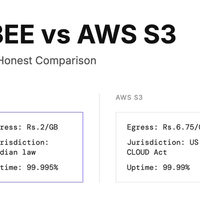
GCS egress to the internet from Mumbai: approximately Rs.10–12/GB. IBEE egress: Rs.2/GB.
GCS operation costs are also higher than IBEE's — Class A operations (writes) cost approximately $0.05 per 10,000 on GCS versus Rs.420/million on IBEE (approximately $0.005 per 10,000 at current rates).
The GCS pricing model has multiple storage classes (Standard, Nearline, Coldline, Archive) with different per-GB rates and retrieval fees, similar to AWS S3. For businesses that want simple, predictable pricing, IBEE's two-variable model is considerably easier to manage.
Data Sovereignty
Google LLC is a US-incorporated company. Data stored in GCS Mumbai is physically in India but legally subject to US law, including the CLOUD Act. Google can be compelled to produce GCS data by US federal authorities regardless of which region it is stored in.
IBEE is an Indian company. Data stored on IBEE is governed by Indian law and accessible only through Indian legal processes.
For regulated sectors in India — BFSI, healthtech, government-facing businesses — the jurisdictional difference between GCS Mumbai and IBEE is the same as the difference between AWS S3 Mumbai and IBEE. Physical presence in India does not confer legal sovereignty.
Uptime and Reliability
Google Cloud Platform's regional SLA for Cloud Storage is 99.9% for single-region configurations and 99.95% for dual-region. IBEE's Tier 4 infrastructure delivers 99.995% uptime.
GCS does not hold independent Tier 4 data centre certification. IBEE's Tier 4 certification provides independently verified infrastructure redundancy standards.
Latency for Indian Users
GCS Mumbai region latency for Indian users is typically 15–40ms, comparable to other hyperscaler Mumbai regions. IBEE's India-first infrastructure delivers sub-5ms latency for Indian users.
The GCP Integration Argument
Where GCS has a genuine, irreplaceable advantage is deep GCP service integration. If your data pipeline runs on Dataflow, your ML models train on Vertex AI, your analytics queries run on BigQuery, and you want minimal configuration overhead — GCS as the storage layer is the right answer because the integration is native.
This is not a use case IBEE can or should compete with directly. GCP-native analytics and ML architectures belong on GCS.
For businesses not using GCP-native services — using GCS purely for file storage, media delivery, user uploads, and backups — there is no GCP integration advantage to offset GCS's higher pricing, US jurisdiction, and proprietary API.
When GCS Is the Better Answer
GCS is the better answer when your architecture is substantially built on GCP-native services — BigQuery, Vertex AI, Dataflow, Cloud Functions triggered by GCS events. The integration value offsets the cost and jurisdiction considerations for these workloads.
When IBEE Is the Better Answer
For general-purpose object storage without deep GCP integration dependencies, IBEE's combination of India-sovereign data custody, Rs.2/GB egress (versus Rs.10��12/GB on GCS Mumbai), Tier 4 reliability, full S3 compatibility, and Rs.1.50/GB-month storage makes a clear case.
For Indian startups not already committed to the GCP ecosystem, using IBEE for storage avoids GCS API lock-in while providing better pricing and genuine India-sovereignty.