For Indian businesses considering Wasabi as a cost-effective S3-compatible storage option.
Wasabi's Appeal
Wasabi built its market position on two pricing claims: flat-rate storage at low cost and no egress fees. Both are broadly accurate for its target use cases — primarily backup, archive, and cold storage for global businesses. Wasabi's S3 API compatibility and straightforward pricing made it a popular choice for the segment of the market that found AWS S3 too expensive and too complex.
For Indian businesses, the picture requires closer examination across three areas: the true cost model, the data residency situation, and the reliability tier.
The 90-Day Minimum Storage Policy
Wasabi's pricing model includes a minimum storage duration policy: objects stored for less than 90 days are billed as if they were stored for 90 days. This is not prominently advertised but is documented in Wasabi's pricing terms.
For static archive workloads — backups retained for months or years, media libraries that rarely change — this policy has no practical effect. For dynamic workloads where objects are created and deleted within days or weeks — temporary upload processing, short-lived generated files, user session data — the 90-day minimum creates an effective multiplier on the stated storage price.
An object stored for 7 days and then deleted is billed for 90 days. A workload that creates and deletes objects continuously — a transcoding pipeline, a temporary file processing queue, a test environment — pays 90 days of storage for every object, regardless of how long it actually exists.
IBEE charges for actual storage duration, prorated to the day. No minimum duration policy.
The Wasabi India Region and Data Sovereignty
Wasabi operates a Mumbai region. However, Wasabi Technologies LLC is a US-incorporated company. Data stored in Wasabi's Mumbai region is stored in India physically but is managed by a US entity subject to US law, including the CLOUD Act.
This is the same jurisdictional issue that applies to AWS Mumbai, GCP Mumbai, and Azure India — the infrastructure is physically in India, but the operating entity is foreign-incorporated and subject to foreign law.
For Indian businesses with no regulatory requirements around data jurisdiction, this may be acceptable. For regulated sectors — BFSI, healthtech, govtech — or for companies with government contracts that require India-sovereign cloud documentation, Wasabi's India region does not provide the sovereignty guarantee that the physical location might suggest.
IBEE is an Indian company. Data stored on IBEE is governed by Indian law and operated by an Indian entity.
Pricing Comparison for Indian Workloads
Wasabi's standard storage pricing is approximately $0.0068/GB-month, which at current INR rates is roughly Rs.0.57/GB-month. This is cheaper than IBEE's Rs.1.50/GB-month for objects that are stored for the full 90-day minimum period.
However, for workloads with dynamic object churn, the effective storage cost on Wasabi is higher than the headline rate suggests. An object stored for an average of 30 days costs three times the stated per-GB price because the minimum billing period is 90 days.
Wasabi's egress is free when downloading directly from Wasabi. For workloads that serve files to end users through a CDN, egress from Wasabi to the CDN may be free, but CDN egress to the end user is still billed by the CDN. The egress-free claim covers Wasabi-to-CDN transfer, not the full delivery chain.
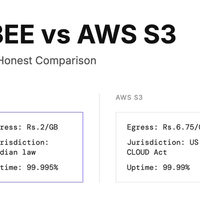
IBEE charges Rs.2/GB egress with no minimum storage duration. For workloads with dynamic object lifecycles, IBEE's total cost is often competitive with or lower than Wasabi's effective cost once the minimum duration policy is factored in.
Reliability and SLA
Wasabi does not hold Tier 4 data centre certification. Wasabi's published SLA is 99.9% availability. IBEE's Tier 4 infrastructure delivers 99.995% uptime.
For backup use cases, the reliability tier distinction may not matter — if backup storage is unavailable for a few hours, the impact is limited. For production workloads, the difference between 99.9% (8.7 hours maximum downtime per year) and 99.995% (26 minutes maximum downtime per year) is material.
S3 Compatibility
Both Wasabi and IBEE implement the S3 API. Wasabi's S3 compatibility covers the most common S3 operations and is well-documented. IBEE's full S3 API implementation means all S3 operations — including less common ones like object locking, bucket replication configuration, and lifecycle rules — behave as expected.
Latency for Indian Users
Wasabi's Mumbai region provides India-region routing, which is comparable to other Mumbai-region cloud providers. Latency from Indian users to Wasabi Mumbai is in the 15–40ms range typical for hyperscaler Mumbai regions.
IBEE's India-first infrastructure topology delivers sub-5ms latency for Indian users. The difference is most visible for applications serving Tier 2 and Tier 3 city users and for latency-sensitive media delivery.
When Wasabi Makes Sense for Indian Businesses
Wasabi is a reasonable option for Indian businesses with cold storage and backup workloads where objects are stored for 90 days or longer, data jurisdiction is not a concern, 99.9% availability is acceptable, and a CDN partnership for egress-free delivery can be arranged.
For long-retention backup storage where cost per GB-month is the primary concern and latency, jurisdiction, and reliability tier are secondary, Wasabi's pricing advantage is real.
When IBEE Is the Better Answer
For active user-serving storage, dynamic workloads with object churn below 90 days, regulated sectors requiring India-sovereign storage, production workloads requiring Tier 4 reliability, and businesses where sub-5ms latency for Indian users matters — IBEE is the more appropriate choice.
The 90-day minimum billing policy, US legal jurisdiction, and 99.9% SLA make Wasabi a poor fit for these use cases regardless of its storage price headline.