
This comparison is meant for businesses trying to choose the right object storage solution. The aim is to give a clear and balanced view of both options, including situations where AWS S3 might actually be the better fit.
Starting Point: Both Are S3-Compatible
AWS S3 is the original implementation of the S3 model, while IBEE follows the same S3 API. That means the core experience is the same, same operations, same SDKs, and existing applications can run on IBEE just by changing the endpoint and credentials. At a basic level, both offer the same object storage functionality.
The differences come in areas like pricing, legal jurisdiction, data sovereignty, uptime guarantees, and the broader ecosystem around them.
Many teams spend a lot of time analysing this, but the decision often comes down to one thing. If your system is tightly integrated with other AWS services, staying on S3 makes sense. If not, IBEE becomes a strong option because of its cost and data control advantages. The real challenge is understanding which situation your setup actually falls into.
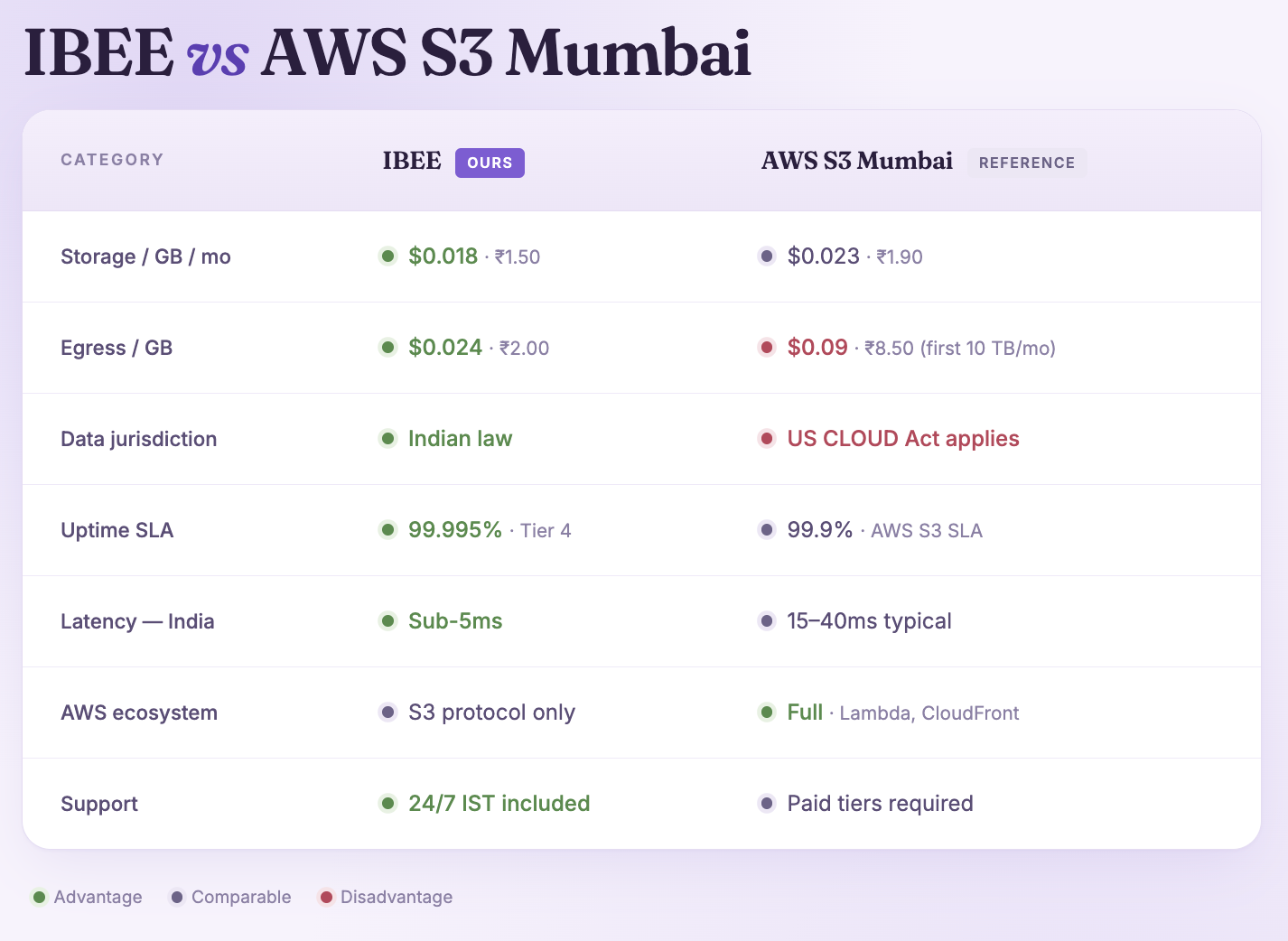
IBEE and AWS S3 across the five dimensions that matter most for storage decisions.
Pricing Comparison
The biggest cost difference between IBEE and AWS S3 shows up in egress, the cost of sending data to users.
Storage pricing is fairly close. IBEE is around ₹1.5 per GB per month, while AWS S3 Mumbai is roughly ₹1.9 per GB per month for standard storage. AWS does offer cheaper archive tiers, but those come with slower access and extra retrieval charges, which reduces their usefulness for frequently accessed data.
Egress is where things really change. IBEE charges ₹2 per GB, while AWS S3 Mumbai is around ₹6.75 per GB for the initial usage tier. Even at moderate scale, this gap adds up quickly. At 50 TB of monthly egress, the difference is in lakhs per month, and it keeps increasing as usage grows.
Uploads are free on both platforms, and API request pricing is also quite similar. IBEE charges for request types like uploads and downloads at rates comparable to AWS.
One practical difference is logging. IBEE includes audit logging with 180-day retention by default, while AWS requires additional services like CloudTrail, which adds to cost and complexity.
The teams that feel this difference the most are usually the ones growing fast. As usage increases, egress grows with it, and the cloud bill starts rising at the same time. That is often when infrastructure decisions become harder to change.
Data Sovereignty and Legal Jurisdiction
This is one of the most important differences, especially for businesses in regulated sectors.
AWS S3 Mumbai is physically located in India, but it is operated by a US-based company. Under the US CLOUD Act, American authorities can request data from US cloud providers globally, even if that data is stored in India. This creates a legal layer that sits outside Indian jurisdiction.
IBEE, on the other hand, is an Indian company operating under Indian law. There is no equivalent mechanism that allows foreign governments to directly access data without going through Indian legal processes. This keeps the chain of control clearer.
For startups building general consumer apps, this may not feel like a major issue. But for sectors like BFSI, healthtech, edtech institutions, or government-related work, it becomes very relevant. The same applies to companies dealing with strict data localisation rules, where who controls the data matters as much as where it is stored.
In real situations, this often comes up during enterprise sales. The key question is not just where the data centre is located, but under which legal system the provider operates. That is where an India-based provider offers a clearer and easier answer.
Uptime and Reliability
IBEE runs on Tier 4 certified data centres, which is the highest level of reliability. This means fully fault-tolerant infrastructure with no single points of failure across power, cooling, or networking. The uptime SLA is 99.995%, which comes out to roughly 26 minutes of maximum downtime per year.
AWS S3 runs on hyperscaler infrastructure with a 99.99% uptime SLA, which is about 52 minutes of possible downtime annually.For most use cases, both are reliable enough. But for systems where storage availability directly affects revenue or operations, like payments, streaming, or trading, that extra reliability margin can make a meaningful difference.
Latency for Indian and Regional Users
IBEE’s infrastructure is designed specifically for Indian network conditions. For users in major cities, latency is typically under 5ms, and even in Tier 2 and Tier 3 locations, local routing helps maintain better performance compared to shared hyperscaler setups, which can range between 15 to 40ms.
For applications where storage response time directly affects users, like media streaming, image-heavy apps, or document access, this lower latency leads to a noticeably smoother experience for users in India and nearby regions.
However, if your users are spread across multiple countries, hyperscalers with global infrastructure may still offer better overall coverage.
Service Ecosystem
This is one area where AWS clearly has an advantage.
AWS offers a large ecosystem of managed services that work directly with S3, like Lambda triggers, CloudFront, Rekognition, and analytics tools. If your system depends heavily on these integrations, S3 fits naturally and works without extra effort.IBEE, on the other hand, focuses on S3-compatible storage. It supports most common storage use cases, but it does not provide the full range of native integrations that AWS does.
So the trade-off is simple. For storage-focused needs like file hosting, media delivery, backups, or user uploads, IBEE is more than enough. But if your setup relies deeply on AWS services, staying on S3 may make more sense despite the higher cost.
Operational Complexity
AWS S3 pricing has 14 storage classes, multiple request categories, data transfer pricing that varies by destination, S3 Select pricing, replication costs, and lifecycle transition fees. The bill requires attention and often a dedicated FinOps function to understand.
IBEE pricing has two active variables: storage at $0.018/GB-month (Rs.1.50/GB-month) and egress at $0.024/GB (Rs.2/GB). The bill is predictable and easy to model. Most teams can estimate their IBEE bill in under five minutes.
For engineering teams that want to understand their infrastructure costs without a dedicated FinOps function, IBEE's pricing model reduces cognitive overhead significantly.
Support
AWS support tiers range from free basic support through paid developer, business, and enterprise tiers. Production-critical support starts at the Business tier, which costs a percentage of monthly spend with a minimum floor. Reaching a human engineer at AWS requires navigating a tiered system.
IBEE provides 24/7 India-based support included with the service, staffed in IST, without a separate support tier purchase. For Indian businesses running operations during Indian business hours, this is a practical advantage.
When AWS S3 Is the Better Answer
For global enterprise setups that depend heavily on AWS services across regions, AWS S3 is usually the better fit. If your architecture relies on things like Lambda triggers, CloudFront integrations, or native event pipelines within AWS, moving away can add unnecessary complexity without much gain.
Large organisations with AWS enterprise agreements and committed usage discounts may also see smaller cost differences, which makes switching less attractive.
And if your users are spread across multiple continents, not mainly in India or South Asia, then IBEE’s latency advantage does not really apply to your use case.
When IBEE Is the Better Answer
For businesses mainly serving users in India or South Asia, where the need is simple storage and file delivery without heavy AWS service dependencies, IBEE often becomes the better choice. Lower egress pricing, clear data sovereignty, Tier 4 reliability, and predictable costs all add up.
This applies to most Indian startups, regional platforms, and companies in regulated sectors that need data to stay within India. It is also relevant for teams that have looked at their AWS bill and noticed how large the egress cost has become.
The migration itself is straightforward, usually just changing the endpoint URL. The cost savings start showing up from the next billing cycle.