
The Multi-Cloud Promise and the Multi-Cloud Reality
The pitch for multi-cloud sounds reasonable: spread workloads across providers, avoid lock-in, use the best service from each. In practice, most Indian enterprises running so-called multi-cloud architectures have simply ended up with AWS for production, GCP or Azure for some analytics or ML workloads, and a growing bill on both platforms that nobody has full visibility into.
In conversations with infrastructure teams across Bangalore, Mumbai, and Hyderabad, we hear a version of this story with enough regularity that it has stopped feeling like an edge case: the multi-cloud decision was made at the architecture stage, the egress bill arrived three months later, and by then the workloads were already too entrenched to move.
The lock-in problem did not go away. It multiplied. Teams are now locked into two vendors instead of one, with inter-cloud egress fees every time data moves between them, compliance ambiguity across both, and an operations team stretched across two different billing models, two IAM systems, and two support queues.
Adding a regional cloud provider like IBEE to this picture is not about replacing AWS or Azure. It is about having at least one layer of infrastructure that is genuinely within your control: India-sovereign, predictably priced, and designed to integrate with the rest of your stack rather than compete with it.
A Real Scenario: The Enterprise That Solved the Wrong Problem
An enterprise technology company in Hyderabad. Core applications on AWS, data analytics workloads on GCP, on-premise data centre for regulatory-sensitive workloads. The architecture team called it hybrid multi-cloud. The finance team called it the most expensive infrastructure decision they had ever made.
The problem was not the architecture. It was the data movement costs. Their analytics pipelines pulled data from AWS S3 into GCP BigQuery daily: 2 TB per run, five days a week. AWS charged egress on the way out. GCP charged ingress processing on the way in. The data pipeline itself cost more per month than the compute that processed it.
The India-resident regulatory workloads on-premise were due for a cloud migration, but the legal team had blocked a move to either AWS or GCP on data residency grounds. Neither platform could provide the India-sovereign documentation the company needed for its government contracts.
The architecture was not the problem. The missing piece was India-sovereign infrastructure that could anchor the regulatory workloads and serve as a neutral, cost-effective storage layer between the two hyperscalers.
Why Hyperscaler Multi-Cloud Creates New Problems While Solving Old Ones
Moving from single-cloud to multi-cloud is often presented as reducing risk. In practice, it introduces a set of costs and complications that teams do not price in at the architecture stage.
Inter-Cloud Egress: The Tax Nobody Budgets For
Moving data between AWS and GCP, or between either hyperscaler and on-premise infrastructure, triggers egress charges on the sending side and sometimes ingress processing on the receiving side. For data-intensive enterprises running regular cross-cloud pipelines, whether ETL jobs, replication, or analytics feeds, this can easily become the single largest line item in the cloud bill.
A 2 TB daily pipeline from AWS S3 to GCP, at AWS Mumbai's confirmed egress rate of Rs.10.37 per GB ($0.1093/GB), costs approximately Rs.20,740 per run. Five runs a week across a full month adds up to around Rs.4,48,280 in data movement costs alone, before any compute or storage expenditure is counted.
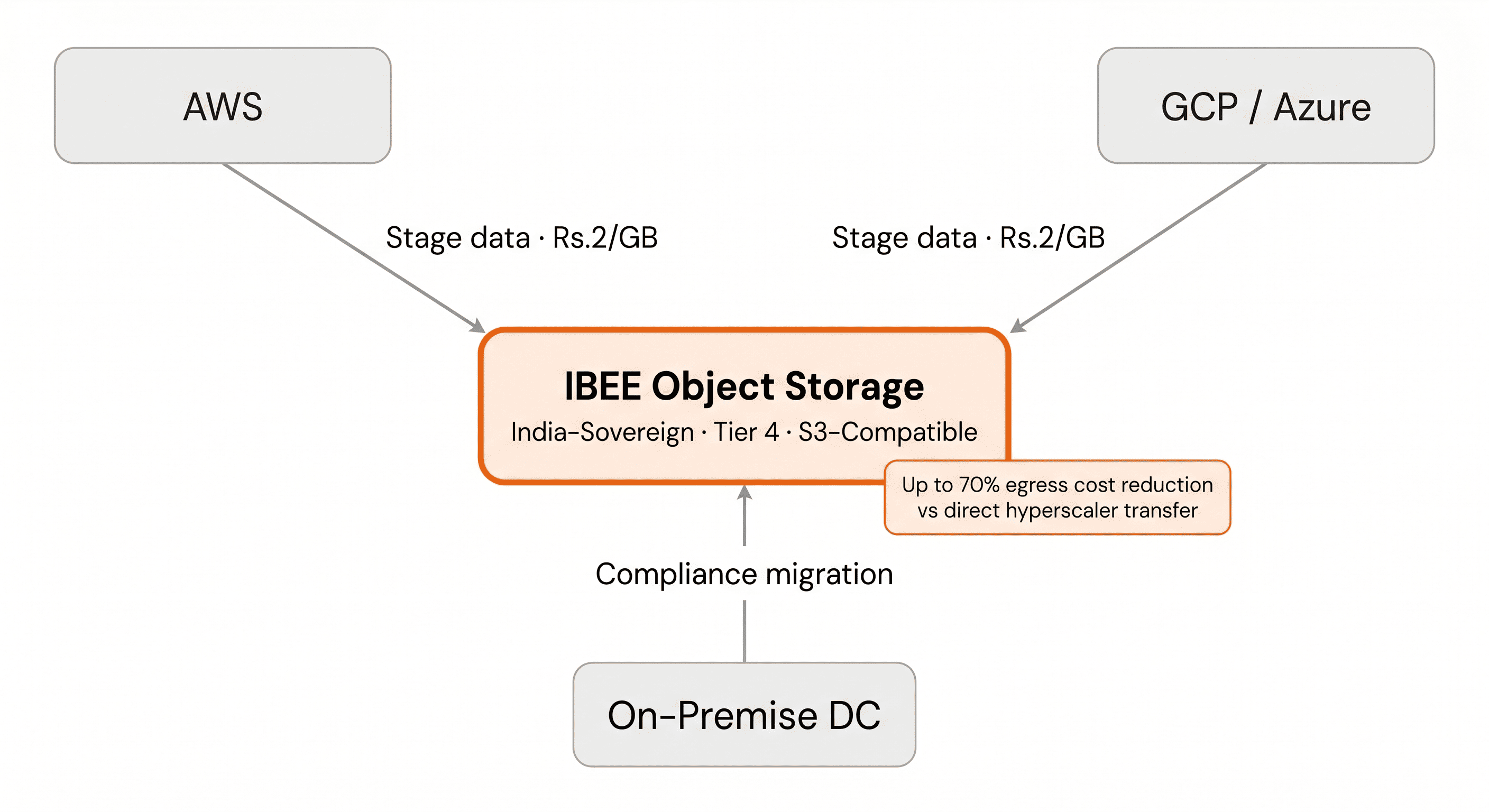
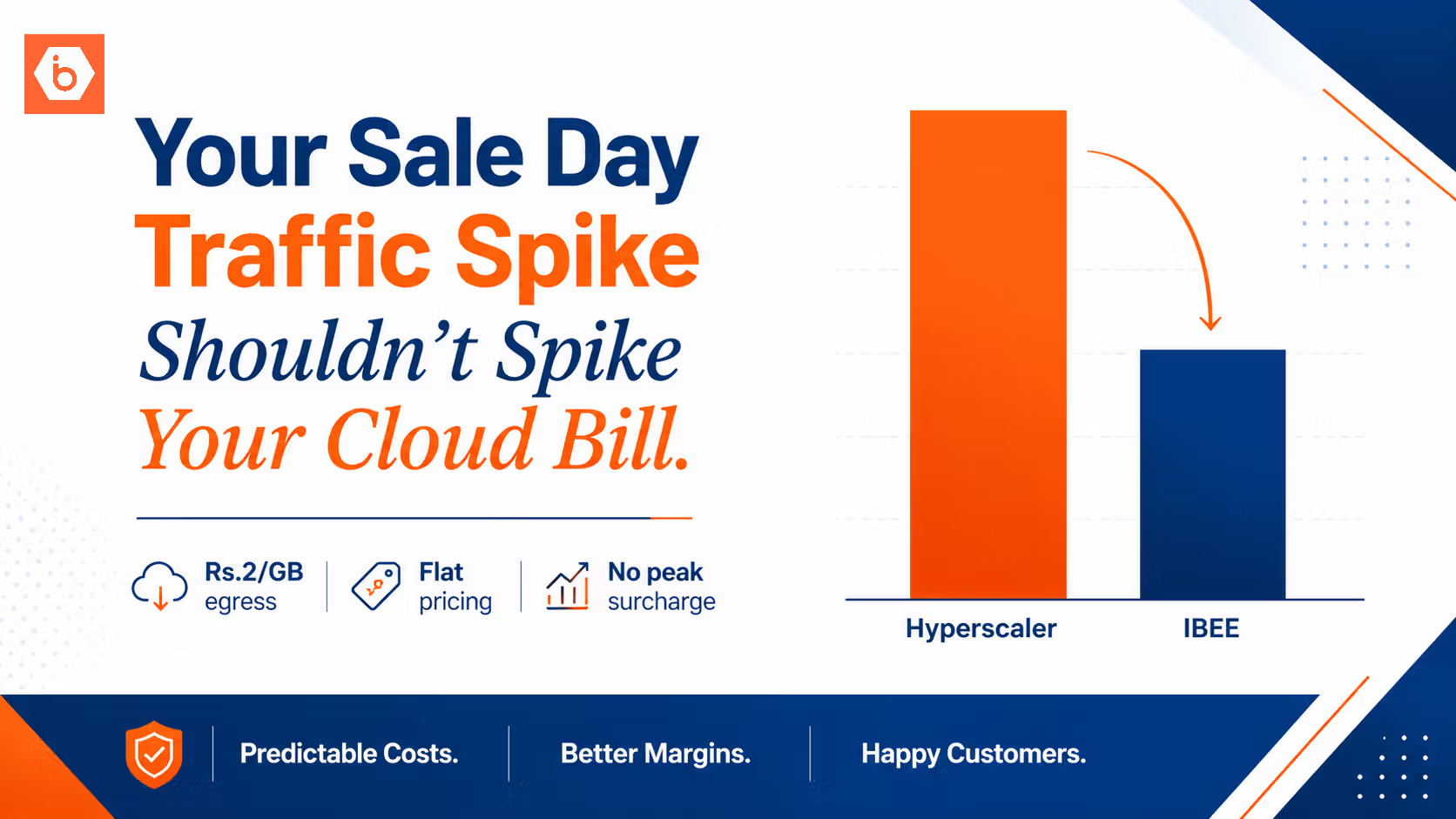
IBEE cuts egress costs by up to 70 percent and anchors compliance-sensitive data under Indian jurisdiction.
Compliance Does Not Simplify Across Clouds
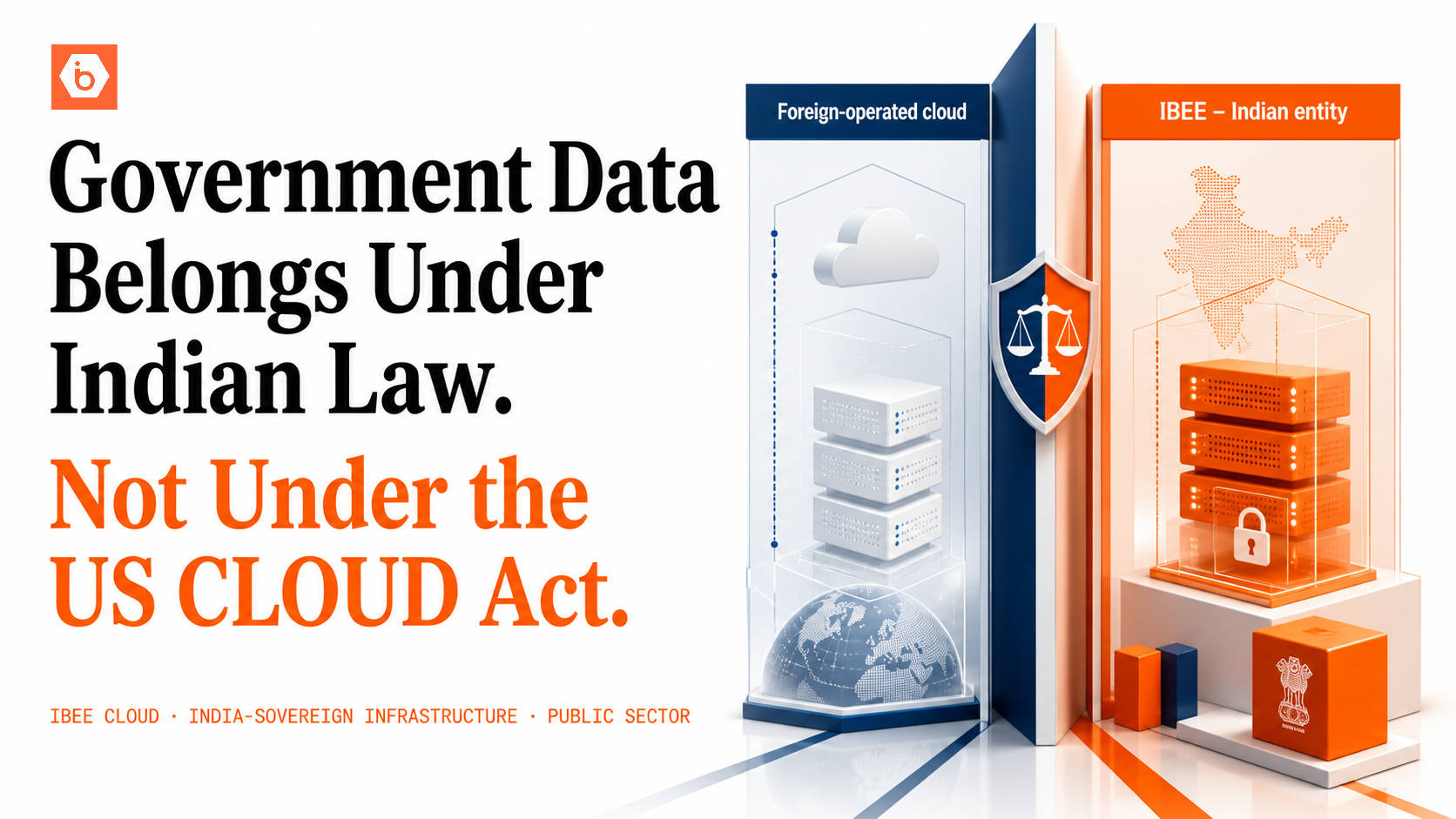
Running workloads across two foreign-operated platforms does not make compliance easier. It makes it harder. Teams end up with two sets of service agreements, two legal entities governed by US law, and twice the surface area for audit questions about where Indian data actually lives and who can access it under what jurisdiction.
For Indian enterprises with government contracts, DPDP Act obligations, or sector-specific regulations from RBI, SEBI, or IRDAI, the question of data residency becomes harder to answer with two hyperscalers, not easier.
We have been in enough pre-audit preparation sessions to understand that "our data is physically hosted in an AWS Mumbai region" and "our data is under Indian legal jurisdiction" are two answers to the same question that produce very different outcomes with compliance reviewers and government procurement committees.
Operational Complexity at Scale
Two cloud providers means two billing systems, two IAM structures, two monitoring setups, two support escalation paths, and two vendor account management relationships. For large enterprises this is manageable. For mid-size Indian companies with lean infrastructure teams, the operational overhead of true multi-cloud eats into the efficiency gains the architecture was supposed to deliver.
Where IBEE Fits in a Hybrid and Multi-Cloud Architecture
IBEE is not a replacement for AWS or Azure. For enterprises already running production workloads on hyperscalers, a rip-and-replace migration is rarely the right answer. What IBEE provides is a third layer: India-sovereign, Tier 4 reliable, and fully S3-compatible, that solves specific problems hyperscalers cannot address by design.
The India-Resident Storage Layer
The most common use case for IBEE in a hybrid architecture is as the designated storage layer for India-resident data: regulatory records, KYC documents, government contract deliverables, audit logs, and any data with explicit Indian jurisdiction requirements. This data is stored on IBEE, governed by Indian law, and available via the same S3 API existing applications already use. It integrates directly into AWS SDK calls, Terraform configurations, and application code with nothing more than an endpoint change.
Reducing Inter-Cloud Egress Costs
For enterprises moving data between hyperscalers, IBEE can serve as a cost-effective intermediate storage layer. Rather than streaming data directly from AWS to GCP, paying AWS egress and GCP ingress on every transfer, teams stage data to IBEE at Rs.2 per GB and transfer onward. For large, regular inter-cloud data movements, this staging approach can reduce transfer costs by up to 70 percent.
On-Premise to Cloud Migration Anchor
Enterprises migrating from on-premise data centres to cloud often face the same legal question: which cloud is appropriate for which data? IBEE provides a clear answer for India-sensitive workloads. Regulatory and compliance-critical data migrates to IBEE's India-sovereign infrastructure, while performance or scalability-driven workloads move to whichever hyperscaler fits that workload type.
Disaster Recovery and Backup for Indian Workloads
Tier 4 data centre infrastructure, with 99.995% uptime, fully redundant power and cooling, and zero single points of failure, makes IBEE a reliable secondary site for enterprise backup and disaster recovery. For organisations that need their DR environment to be within Indian jurisdiction, IBEE is the only Tier 4 option that satisfies this requirement by design rather than by configuration.
Dev and Test Environments
IBEE's free tier provides 25 GB storage and 50 GB egress per month at no cost, with no payment method required. That straightforward starting point, combined with pay-as-you-go pricing from that point forward, makes IBEE a practical choice for development, staging, and test environments. Teams keep production on AWS or Azure and run dev and test on IBEE, reducing the cost of non-production environments without any architectural change.
How IBEE Compares to Hyperscalers in a Hybrid Context
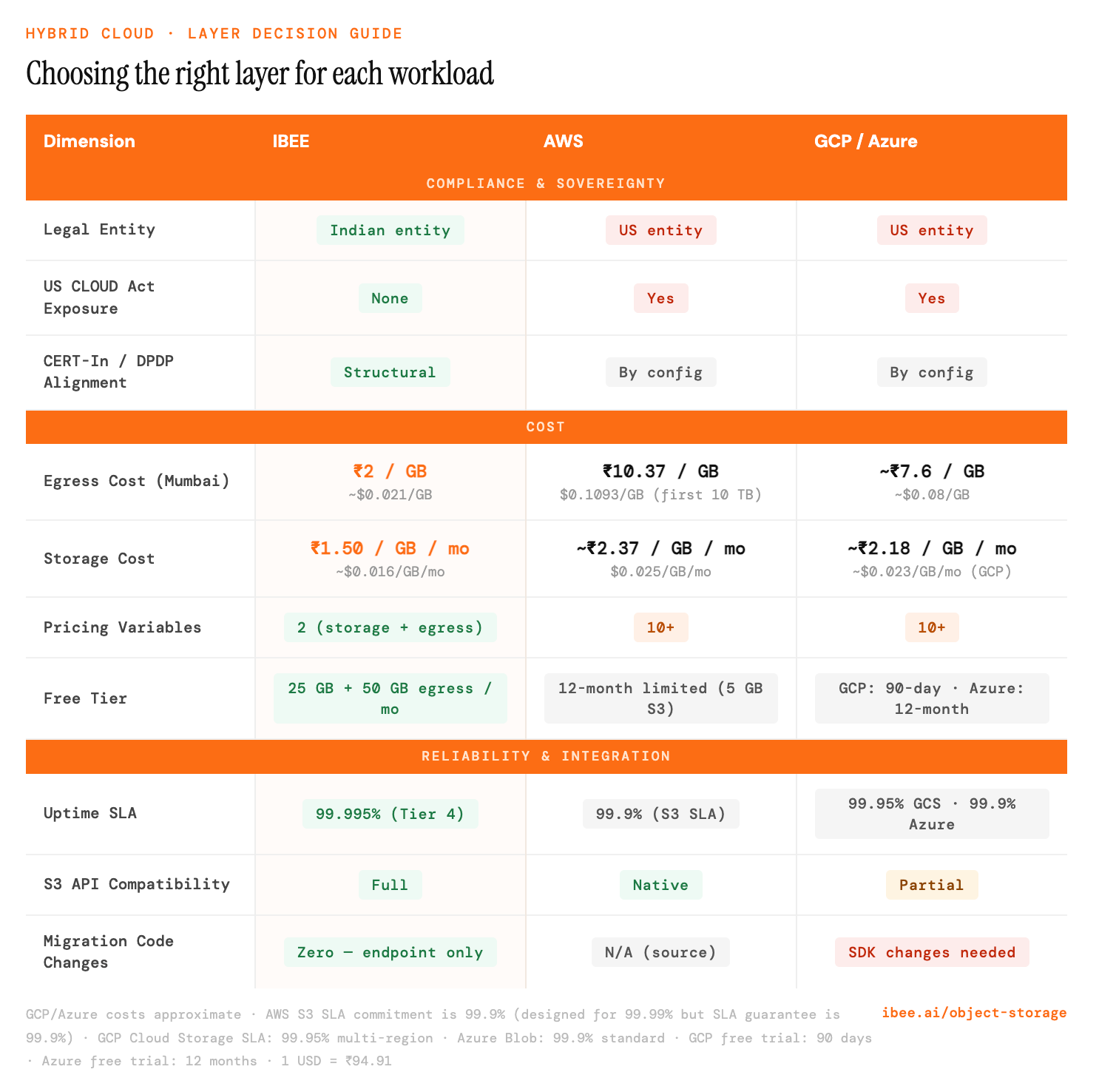
Each cloud is suited for different layer.
The Compliance Anchor Problem in Indian Enterprise Hybrid Cloud
For large Indian enterprises, particularly those in regulated sectors or with central and state government clients, hybrid cloud architecture often has an implicit requirement that is not always stated clearly in the design document: at least one layer of the stack needs to be demonstrably under Indian jurisdiction.
AWS and GCP can document physical location in India. They cannot document Indian legal sovereignty. For the workloads where that distinction matters, and in Indian enterprise it increasingly does, IBEE provides the compliance anchor that the rest of the architecture can reference.
Government contract deliverables stored on IBEE. Regulatory records retained on IBEE. Audit logs maintained on IBEE under CERT-In's 180-day retention requirement. The hyperscaler layers handle what they do best: compute scale, managed services, global reach. IBEE handles what they structurally cannot, which is India-sovereign data custody.
Getting IBEE Into Your Existing Architecture
Because IBEE is fully S3-compatible, integration into an existing AWS or multi-cloud environment is straightforward. Teams we have worked with have typically completed the initial connection in under a working day: update the endpoint, rotate the credentials, run a validation transfer on a non-critical bucket, and the pipeline is live. The resistance is almost never technical.
In most cases the integration path involves updating the relevant S3 endpoint URL to IBEE's endpoint, rotating the access credentials, and optionally updating bucket policies and IAM configurations. Existing application code, Terraform modules, Kubernetes storage classes using the S3 CSI driver, and CI/CD pipelines using AWS CLI all work without modification.
For enterprises using data movement tools like AWS DataSync, rclone, or custom ETL pipelines, IBEE's S3 compatibility means those tools connect without any additional configuration.
Making the Case Internally
The internal conversation about adding IBEE to an existing multi-cloud architecture usually comes down to four questions, and the answers to all four are straightforward.
Does it actually integrate? Yes: full S3 API compatibility, compatible with existing tooling and IaC without modification.
What does it cost? Rs.1.50 per GB per month for storage and Rs.2 per GB for egress, with no subscriptions and no minimum commitment.
What problem does it solve that AWS or Azure cannot? India-sovereign data custody with documented regulatory alignment, Tier 4 reliability at a predictable cost, and a cost-effective egress layer between hyperscaler environments.
Is it reliable enough? Tier 4 certified infrastructure, 99.995% uptime SLA, and a fully fault-tolerant architecture built for enterprises with zero tolerance for storage downtime.
Those four answers cover most of what an architecture review board, a finance team, or a compliance function needs to approve the addition of IBEE to an existing multi-cloud strategy.
Where to Start
Start with the workload that creates the most friction in the current architecture: most likely either a compliance-sensitive dataset that has been blocked from hyperscaler migration, or an inter-cloud data pipeline whose costs have grown beyond the original budget.
Migrate that workload to IBEE. Validate the integration with existing tooling. Run it for 90 days alongside existing infrastructure. The results will make the case for the next workload.