The Uptime Calculation Most Teams Get Wrong
When an e-commerce platform goes down for 30 minutes during a sale, the loss is not just that time window. It shows up as abandoned carts, failed orders, refunds, and users who may not return.
In healthcare, the impact is even more serious. If a diagnostic system is unavailable, it leads to delays, incomplete decisions, and loss of trust.
Uptime may look like just a percentage in an SLA, but its real impact is on revenue and operations. A 99.9% SLA allows about 8.76 hours of downtime per year. For a business doing around ₹50 lakh a day, even a few hours of disruption can mean significant loss.
IBEE’s Tier 4 setup runs at 99.995%, which is about 26 minutes of downtime annually. That gap between hours and minutes is not small, especially when downtime usually happens during peak or critical moments.
Most teams only realise this difference when something actually breaks.
What Tier Classifications Actually Mean
The Uptime Institute's data centre tier classification system is the global standard for measuring data centre reliability. It is a physical infrastructure standard, not a software or configuration standard.
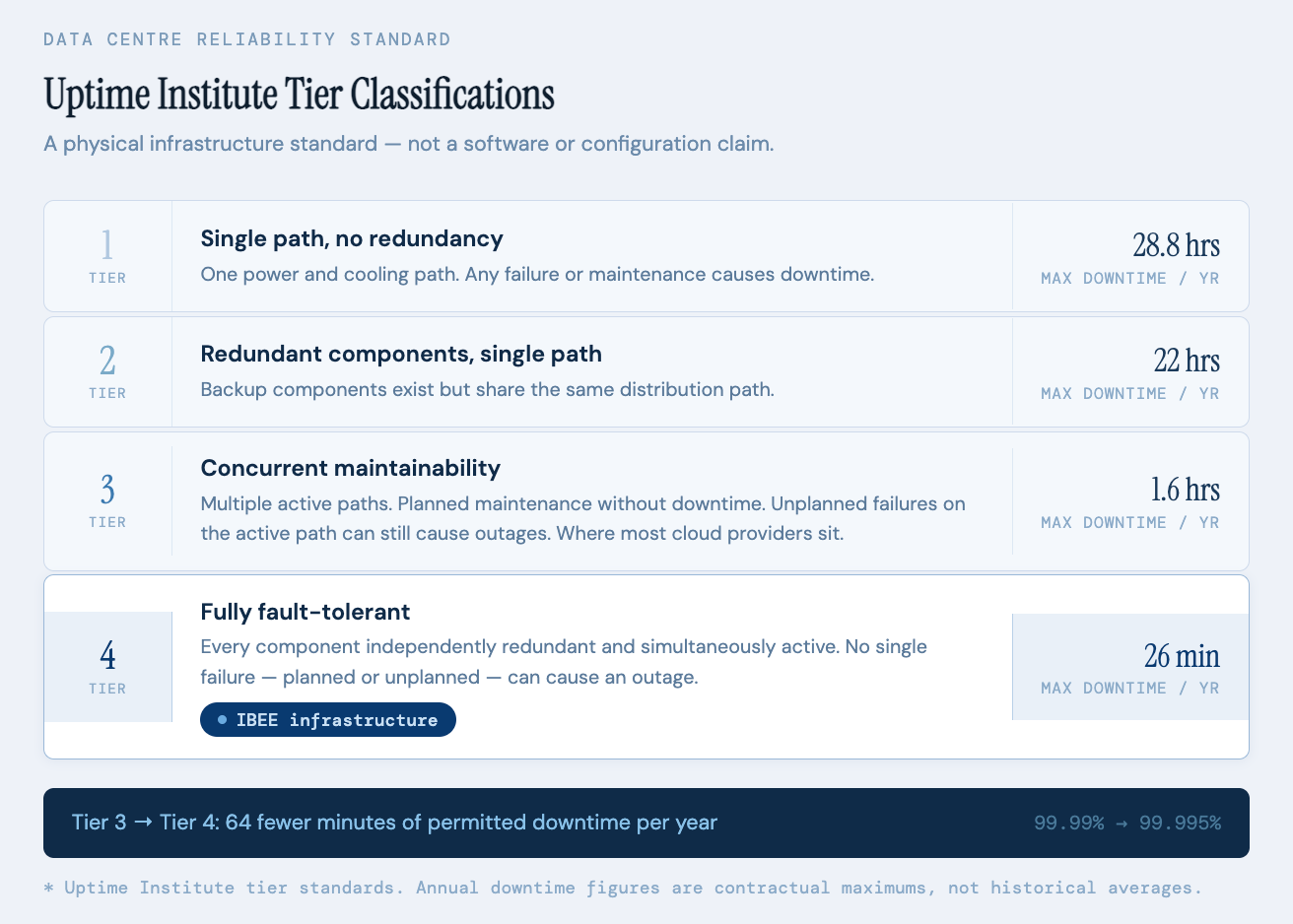
Tier 3 handles planned failures. Tier 4 handles unplanned ones too.
Why Tier 3 Is Not Good Enough for Certain Workloads
The gap between Tier 3 and Tier 4 only really shows up when something fails unexpectedly. And by definition, those are the failures you did not plan for.
A Tier 3 data centre is built to handle planned events well. Maintenance can happen without downtime because there is a backup path in place. An engineer can work on power or cooling systems while the secondary setup keeps things running. This is called concurrent maintainability, and it works for situations you can schedule in advance.
But the limitation appears when something unplanned happens. If the active system fails at a time when the backup path is already under maintenance or has an issue of its own, Tier 3 cannot guarantee that the system will stay up. These edge cases are rare, but they do happen, and that is where outages come from.
Tier 4 is designed to remove this risk entirely. Every system path is active and capable of handling the full load at all times. This means even if one component fails, whether planned or not, the system continues running without interruption. There is no single failure scenario that can take everything down.
A common thought from engineering teams is, “We have never faced a major outage so far, so our current setup is fine.” That logic works until the first serious incident happens. The problem is that you only get to test this assumption when something goes wrong.
Tier 4 is meant for teams that do not want to rely on that kind of uncertainty. If the cost of even a couple of hours of downtime in a year is higher than the savings from cheaper infrastructure, then Tier 3 becomes a risk. And if an outage can lead to compliance issues, financial penalties, or long-term customer impact, then Tier 4 is not an upgrade, it is the baseline you need.
The Workloads That Need Tier 4
Payment systems are at the top when it comes to reliability needs. Even a few minutes of downtime can lead to failed transactions, lost revenue, and regulatory attention. In most regions, uptime for payment infrastructure is not just expected, it is part of compliance.
Healthcare systems come next. Platforms handling diagnostics, patient records, or telemedicine are directly tied to clinical workflows. If they go down, it affects real decisions and patient care. A two-hour outage is not just a technical issue, it becomes a clinical incident.
Banking and financial services also operate under strict uptime requirements. Core systems like banking platforms, trading engines, and lending systems need reliability that can be shown to regulators, not just assumed from experience.
E-commerce platforms feel this pressure during peak events. Sale days and product launches push more traffic in a single day than usual. That is when infrastructure is tested the most, and failures become expensive very quickly.
Government and public sector platforms have a different kind of impact. When they go down, citizens often have no alternative, so downtime directly affects public services.
Enterprise systems like ERP and HR also have critical timing. Payroll, financial closing, and procurement processes depend on systems being available at the right moment. Missing those windows can create issues that go beyond the original downtime.
IBEE's Reliability Architecture
IBEE’s Tier 4 data centres in India are designed with fully fault-tolerant infrastructure, built to maintain 99.995% uptime.
This includes 2N power setup with independent UPS systems, diesel backup, and automatic failover, so there is no single point of failure in power. Cooling is handled with N+1 redundancy and separate circuits, which avoids shared failure risks. Network connectivity comes from multiple providers with automatic failover, removing dependence on a single carrier. Data is distributed across multiple drives and nodes, with automatic recovery if any part fails. Physical security is also tightly managed with biometric access, CCTV, and 24/7 monitoring.
The idea here is simple. Components will fail at some point, that is expected. What matters is whether any single failure can take the system down. In a Tier 4 setup, it cannot.
Uptime and Compliance
For businesses in regulated sectors, uptime is no longer just an operational concern, it is part of compliance. This is true globally, and even more relevant in India.
In India, CERT-In’s 2022 guidelines require organisations to have incident response systems and report incidents quickly. RBI and IRDAI also define availability expectations for financial and insurance systems. These are not optional, they are part of regulatory requirements.
The same pattern exists globally. Standards like PCI-DSS for payments, HIPAA for healthcare in the US, FCA rules in the UK, and DORA in the EU all expect systems to be reliable and auditable. The rules may differ, but the expectation is the same, infrastructure availability must be documented and provable.
Tier 4 certification helps here because it provides a clear, recognised standard of reliability. It gives organisations something concrete they can show auditors to demonstrate that their infrastructure meets required availability levels.
What to Ask Your Cloud Provider
When evaluating cloud infrastructure reliability, four questions matter more than the rest.
Is the data centre Tier 4 certified, or does it claim "Tier 4 equivalent"? Tier 4 equivalent is marketing language. Certification from the Uptime Institute or TIA-942 is an audit-verified standard. The distinction matters when an auditor or an enterprise client asks for documentation.
What is the uptime SLA on object storage specifically? Some providers offer strong compute uptime guarantees but weaker storage guarantees. Storage availability is what matters for most application workloads.
Is there financial compensation in the SLA for downtime? An SLA without service credits for breach is not a guarantee. It is a statement of intent.
What is the historical uptime track record? Providers with Tier 4 infrastructure should be able to provide historical availability records, not just contractual commitments.
IBEE offers 99.995% uptime backed by Tier 4 infrastructure, with transparent SLA terms and India-based support available 24/7 for incident escalation.