The Cloud Bill That Arrives After Your Best Sales Day
Your sale just ended. 3.2 lakh orders. 14 million product page views. Every listing loaded its images, every buyer downloaded their invoice, every seller pulled their daily report. It was the best 24 hours in your company's history.
Then the cloud bill arrived. And the storage line, the one your CFO never pays much attention to, had tripled.
Nobody stole anything. Nobody misconfigured anything. Hyperscaler egress pricing worked exactly as designed. Every product image that loaded in a browser, every thumbnail that appeared in a search result, every catalogue PDF a seller downloaded triggered an outbound data transfer charge. At scale during a sale event, egress does not just grow. It compounds.
Every Indian e-commerce platform hits this at some point: the infrastructure that powers your best days ends up generating your worst invoices.
A Real Scenario: The D2C Brand That Discovered Its Image CDN Had a Silent Partner
A D2C fashion brand based in Delhi. 85,000 SKUs, 4,000 high-resolution product images added every month, growing seller base. Their platform was solid: images stored in an S3-compatible bucket on a major hyperscaler's India region, served through a CDN.
For two years, the storage bill was manageable. Then three things happened simultaneously.
They ran their first Republic Day sale, tripling daily traffic for 72 hours. The egress bill for those three days exceeded the entire previous month's storage cost.
Their product team invested in higher-resolution photography to improve conversion. Average image size went from 180KB to 420KB per SKU. Storage costs rose 2.3x overnight on the same number of products.
They expanded seller onboarding, and each new seller's catalogue added not just storage but ongoing egress as buyers browsed their listings. The cost per active seller had become unpredictable.
Their CTO ran the numbers. 78% of their cloud storage spend was egress, not storage itself. Every time a customer in Indore or Surat or Coimbatore browsed their app, they were paying Rs.8 to 11 per GB of images served. On a platform with 14 million monthly active users browsing an average of 40 product images per session, the numbers were brutal.
The problem was not growth. The problem was that their cloud pricing model was designed to make growth expensive. Hyperscaler egress is not an oversight. It is a revenue mechanism. The more successfully your platform serves Indian users, the more you pay for the privilege.
We have had versions of this conversation with more e-commerce CTOs than we can count. The numbers are always slightly different. The structure is always the same: a pricing model that looked reasonable at Rs.2 crore GMV starts looking punishing at Rs.20 crore.
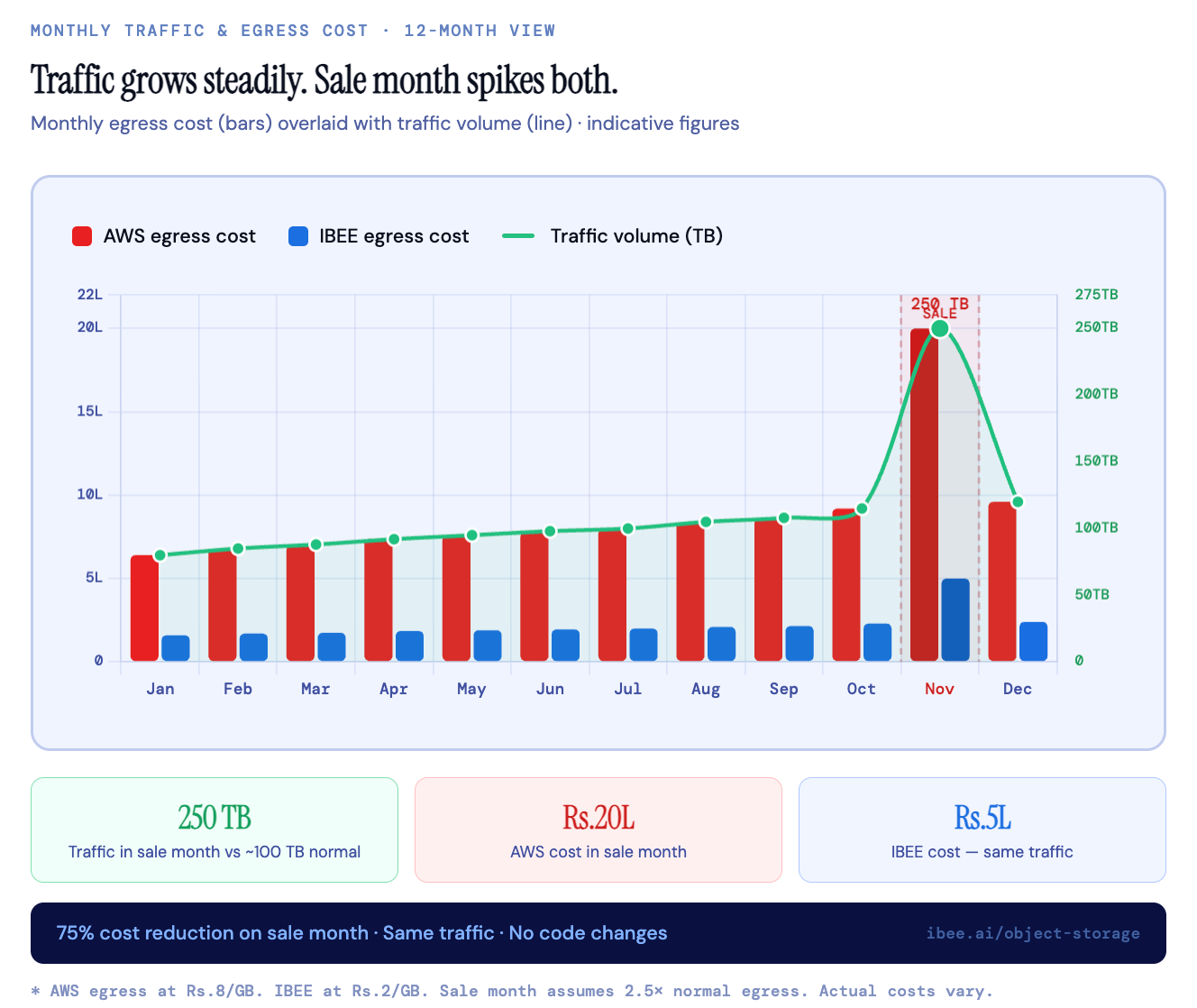
On hyperscaler pricing, your best trading days generate your highest infrastructure bills.
Why Hyperscaler Cloud Is the Wrong Fit for Indian E-commerce
E-commerce is one of the most egress-intensive workloads in existence. Every product impression, every image load, every video preview, every document download is an outbound data transfer event. The hyperscaler pricing model, designed for enterprise workloads where egress is a minor cost component, creates a systematic overcharge for e-commerce platforms at scale.
The Egress Problem Is Structural
AWS, GCP, and Azure charge Rs.6.50 to 11/GB for data transferred out to the internet. For an e-commerce platform where the entire value proposition is getting product content in front of customers, egress is not an edge cost. It is the primary cost of serving your core product. A platform with 10 million monthly active users, each loading 40 images per session at 300KB average, generates approximately 120 TB of monthly egress. At hyperscaler rates, that is Rs.8 to 13 lakh per month in egress alone.
Tier 2 and Tier 3 India Is Where Growth Is
India's e-commerce growth is increasingly driven by customers in smaller cities: Patna, Rajkot, Vijayawada, Siliguri. These are high-growth markets and also markets where the latency difference between truly local infrastructure and a global cloud's India availability zone is felt most sharply. Slow image loads, delayed page rendering, and sluggish checkout flows have a direct, measurable impact on conversion rates.
A 1-second improvement in page load time improves conversion by approximately 7% for Indian e-commerce. For a platform doing Rs.50 crore GMV per month, that conversion delta is worth Rs.3.5 crore annually from infrastructure latency alone.
Sale Events Amplify Every Pricing Problem
E-commerce traffic is spiky. A regular Tuesday and a sale-day Friday are not the same workload. On hyperscaler pricing, every dimension of cost — egress, API calls, request volume — spikes during your highest-value days. The infrastructure cost structure is exactly inverted from what a business needs: cheap on slow days, expensive on the days that matter most.
Seller Catalogue Scale Creates Compounding Storage Costs
Marketplace platforms have a specific data profile: millions of seller-uploaded images, product videos, catalogues, and compliance documents. Each new seller onboarded adds not just storage but ongoing egress as their products are browsed. On hyperscaler pricing, there is no mechanism to contain this growth in a predictable way.
How IBEE Solves the E-commerce Cloud Problem
IBEE Hosting operates from Tier 4 certified data centres in India, delivering 99.995% uptime SLA with India-first network optimisation and straightforward pricing built for exactly the workload profile that e-commerce creates.
Egress Pricing That Does Not Punish Scale
IBEE charges Rs.2/GB for internet egress versus Rs.6.50 to 11/GB on major hyperscalers. For an e-commerce platform where egress is the dominant cost driver, this single difference changes the economics of growth. A platform paying Rs.10 lakh per month in egress on AWS pays Rs.2 to 2.5 lakh on IBEE for the same traffic volume. During a sale event, when egress spikes, the cost advantage is at its largest. IBEE's pricing does not have a peak pricing mechanism. Sale day traffic costs the same per GB as a quiet Tuesday.
Sub-5ms Latency for Tier 2 and Tier 3 Indian Customers
IBEE's India-first infrastructure is optimised for Indian network topology, not a shared global availability zone with a Mumbai endpoint label. Product images load faster for customers in Patna, Nagpur, Jodhpur, and Guwahati, the cities where Indian e-commerce growth is actually happening. Faster image loads mean lower bounce rates, higher session depth, and better conversion, particularly on mobile where the majority of Indian e-commerce traffic originates.
Tier 4 Reliability for Sale-Day Traffic Spikes
Sale events are not the time for infrastructure surprises. Tier 4 data centre certification means fully fault-tolerant infrastructure: redundant power, cooling, and network paths with no single points of failure. For a platform where a one-hour outage during a sale event costs lakhs in lost GMV, 99.995% uptime is not a nice-to-have. It is the minimum acceptable standard.
Full S3 API Compatibility
IBEE Object Storage is fully S3-compatible. Your existing image upload pipelines, CDN integrations, seller onboarding workflows, and media processing queues work without code changes. The migration from AWS S3 is an endpoint URL and credential update, not a platform rebuild.
Predictable Costs That Scale With Your Catalogue
IBEE's pricing has two variables: storage per GB-month and egress per GB. No API call complexity, no intelligent tiering to manage, no archival class penalties for older product images. As your catalogue grows — more sellers, more SKUs, higher-resolution assets — the cost scales predictably. Your finance team can model storage costs 12 months forward without a cloud cost specialist.
Data Residency for DPDP Compliance
Indian e-commerce platforms handle payment data, delivery addresses, purchase history, and increasingly KYC information for credit and BNPL products. IBEE's 100% India-sovereign storage means this data stays under Indian legal jurisdiction, a requirement for DPDP Act compliance as data fiduciary obligations for e-commerce platforms are formalised.
Handling Sale Day Traffic Spikes: Load Balancing and Storage Architecture
Most e-commerce engineering teams think about sale day traffic as a compute problem — scaling application servers, adding read replicas, pre-warming caches. The storage layer is often an afterthought. It should not be.
During a sale event, the storage layer takes three kinds of hits simultaneously: read-heavy traffic as millions of users browse product images; write traffic as orders are placed and invoices generated; and API traffic as seller dashboards refresh report data. On a poorly architected storage layer, these three workloads compete for the same resources and amplify each other's latency.
The architecture that handles this cleanly separates these concerns:
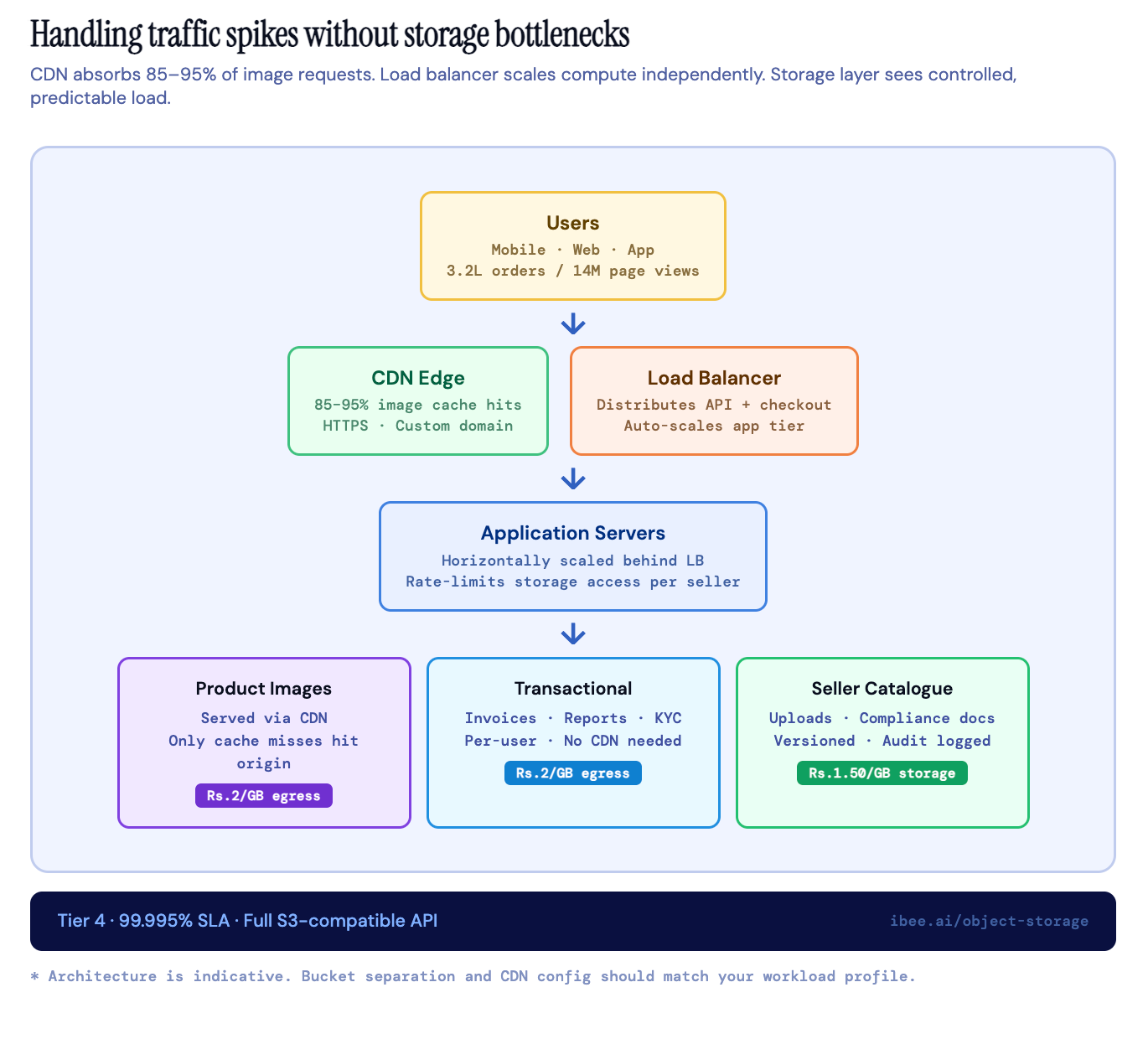
Product images and static catalogue assets live in a dedicated IBEE bucket, served through a CDN. The CDN absorbs 85 to 95% of image requests during a sale event, with the IBEE bucket handling only cache misses. This means the storage layer sees a fraction of the total image traffic.
Transactional assets — order invoices, payment receipts, seller reports — go to a separate bucket with no CDN. These are per-user, per-session files that cannot be cached. The bucket is sized for this workload independently.
The application load balancer sits in front of the compute layer, distributing incoming requests across application server instances. The key architectural decision is that the load balancer never routes traffic directly to the storage layer. All storage access is mediated through the application tier, which can implement request queuing, rate limiting per seller, and circuit breaking if the storage layer comes under stress.
During a sale event, this architecture means that adding compute capacity — scaling the application tier behind the load balancer — does not proportionally increase storage load. The CDN absorbs the image traffic increase. The application tier absorbs the transaction traffic increase. The storage layer sees a controlled, predictable load regardless of the spike multiplier on the front end.
CDN absorbs image traffic. Load balancer distributes compute load.
How IBEE Compares to AWS S3 for E-commerce
For e-commerce, the comparison comes down to two numbers that directly affect revenue: egress cost and latency.
Egress: IBEE charges Rs.2/GB. AWS S3 Mumbai charges Rs.6.50 to 11/GB. For a platform where every product image, every invoice download, and every catalogue request is an egress event, this is the line item that determines whether infrastructure costs scale reasonably with GMV or spiral ahead of it.
Latency: IBEE's India-first infrastructure delivers sub-5ms object retrieval. AWS Mumbai runs 15 to 40ms for most Indian users, with the gap widening for customers in Tier 2 and Tier 3 cities.
Storage cost: Rs.1.50/GB-month on IBEE versus approximately Rs.1.90/GB/month on AWS.
Pricing predictability: IBEE's model has two variables — storage and egress. AWS S3 has 14 storage classes and multiple pricing dimensions. Your finance team can model IBEE costs in a spreadsheet.
Uptime SLA: 99.995% on Tier 4 infrastructure versus 99.99% on AWS. For a platform where a sale-day outage costs lakhs per hour, the reliability tier matters.
Local support: 24/7 India-based team on IBEE. AWS routes through a global support queue.
The egress gap is the headline number for e-commerce, but the latency difference is the conversion number. Together they make the case: IBEE is cheaper to operate and produces a faster product experience for the customers who matter most to Indian e-commerce growth.
Stop Paying Peak Prices for Your Best Days
The e-commerce platforms that will scale most efficiently in India's next growth phase are the ones whose infrastructure costs scale predictably with revenue, not the ones paying a hidden tax on every product image their customers view.
Whether you are a D2C brand managing a product image library, a marketplace operator handling millions of seller-uploaded assets, a grocery delivery platform storing order and fulfilment records, or a fashion platform running high-resolution catalogue photography at scale, IBEE is the infrastructure that grows with your business without punishing you for growing.
No credit card. No subscription. No minimum commitment. Try now - https://ibee.ai/